Registration No.:
137081/072/073


Arun Valley Trek


Trip Difficulty
Easy

Max. Altitude
3,350m./10,991ft.

Meal
kathmandu - BB plan & Trekking - BLD

Accommodation
4* hotel in Kathmandu & Teahouse/Lodges on Trekking

Trip Duration
13 Days

Group Size
1-12 People
Price Starts From
US$ 1465
-
1 person
US$ 1465
-
2 -
5 person
US$ 1315
-
6 over
9999
US$ 1245
US$ 1465

Need Help?
Ask to Travel Expert
Trip Highlights
- Experience bird watching and trek through a wild, untouched trail in the remote Himalayas.
- Enjoy a less-touristic and peaceful trekking route, offering solitude in nature.
- Witness the breathtaking snowy landscapes of the Everest and Makalu regions.
- Explore the historical and culturally rich city of Kathmandu before the trek.
- Immerse yourself in Nepali culture, traditional lifestyles, and ethnic costumes.
- Visit the charming villages of Arun Valley and Lukla, rich in natural beauty.
- Admire stunning views of Mt. Everest, Mt. Makalu, Mt. Amadablam, Mt. Baruntse, and other peaks.
- Walk through enchanting rhododendron forests, especially vibrant during spring.
Introduction of Arun Valley Trek
Arun Valley Trek is one of the most untouched, less touristic trekking destinations of Nepal. The trekking route goes between Khumbu and Makalu regions. This fascinating trekking destination is flourished with Himalayan scenery, natural beautiful wilderness and entire cultural settlement. The trekking trial start from the world deepest valley. It is suitable for two weeks holiday for Nepal trekking.
Arun Valley trek offers you the superb Himalayan scenery including the Mount Everest, Mt. Makalu, Mt.Baruntse, Mt.Lhotse, Mt.Nuptse ,Mt. Amadablam, Mt.Thamserku etc , more than 600 species of birds and over 800 species of butterflies, shelter of the rare and endangered Panda. Combining natural scenery, green lush forest and wildlife and the cultural exploration is the major attracts of this trek.
The thrilling route of Arun Valley Trek Travels through several remote areas to meet up with the main Everest trail at the high elevation airport of Lukla. Lukla is the gateway of Khumbu region trekking. The Arun Valley Trekking can be easily combined with Everest Trek.
Arun Valley is mostly inhabitant by Sherpa, Rai and Limbu who are influenced by Tibetan culture. Still today, local people of Arun Valley follow their own culture and tradition.
Arun Valley Trekking is perfect for those who seek adventurous. The path travels through lush forests and isolated territory. This area is less touristic area. So, the movement of people will be very less, that makes your trek more adventure and peaceful.
Arun Valley trek starts with a scenic flight from Kathmandu to Tumlingtar and the gradually trek into the highlands of Everest Trekking region. This fascinating trek passes through some of the best sightseeing villages, cultural hub, religious shrines and monasteries, snow covered region and the high landers settlement of Sherpa people. Commencing Arun Valley trek will let you explore the natural sightseeing and experience the culture and hospitality of the Sherpa people of Khumbu Region.
Graceful Adventure Travel, can manage Land or Air transportation according to your preference. We provide experienced Guide and Porter with full knowledge about the destination that ensure safety and ease.
Outline Itinerary
| Day | Particular (from) | Time | Elevation(m) | Meal |
| 1 | Arrival at Kathmandu | 1400 | BB | |
| 2 | Sightseeing at Kathmandu | 1400 | B L D | |
| 3 | Flight to Tumlingtar and trek to Chyawabesi | 5-6 | 280 | B L D |
| 4 | Trek from Chyawabesi to Gothy Bazar | 5-6 | 750 | B L D |
| 5 | Trek from Gothy bazar to Salpa phedi | 5-6 | 2850 | B L D |
| 6 | Salpa phedi to sanam via Gurase | 5-6 | 2850 | B L D |
| 7 | Trek from Sanam to Bung | 6-7 | 1800 | B L D |
| 8 | Trek from Bung to Gaikharka | 5-6 | 2300 | B L D |
| 9 | Trek from Gaikharka to Panggom | 6-7 | 2846 | B L D |
| 10 | Trek from Panggom to Puyian | 6-7 | 2640 | B L D |
| 11 | Trek from Puyian to Lukla | 4-5 | 2860 | B L D |
| 12 | Flight back to Kathmandu | 35min | 1400 | BB |
| 13 | Final Departure | BB |
Arun Valley Trek Detail Itinerary
1
Day 1: Arrival Day in Kathmandu
Arrive at Tribhuvan International Airport, which lies in the capital city of Nepal. Our company representative will be there to receive at the Airport with the holding board. You will then escort to the hotel preferred by you.
Activity: Arrive Kathmandu
Meal: Welcome Meal
Accomodation: 4* hotel
2
Day 2: Kathmandu Sightseeing and Preparation for trek
Kathmandu valley is famous for its religious monuments where 7 heritage sites (Kathmandu Durbar Square, Bhaktapur Durbar Square, Patan Durbar Square, Pashupatinath, Boudhanath, Swaymbhunath, Changunarayan Temple) are listed in World Heritage Sites by UNESCO.
Your day starts in the late morning after breakfast. A guide will take you to the historical places and provide detailed information about the culture, architecture, monuments, lifestyle of people, festivals. After half day sightseeing you will be driven back to the hotel and will be briefed about the trek.
Activity: Explore Kathmandu
Meal: BB
Accomodation: 4* hotel
3
Day 3: Flight to Tumlingtar and trek to Chiyabesi
Early in the morning, we prepared for a trip. We take morning breakfast at the hotel then leave the hotel for Airport. The flight will depart from Kathmandu to Tumlingtar. On arrival in Tumlingtar, our experienced local porter will meet you. Tumlingtar is a small city in eastern Nepal which is located between the twisting Arun and Sabha River in Koshi zone. We will start our trek through villages, green meadows and lofty hills.
Activity: Fly to Tumlingtar & Trek to Chiyabesi
Meal: Breakfast, lunch & Dinner
Accomodation: Teahouse / Lodge
4
Day 4: Trek from Chiyabesi to Gothy Bazar (750m)
Today, we will pass through the fields and then walk among terraced rice meadow on the shore of the ArunKoshi, eventually we will swing into the petite village of Balawabesi. The track moves up into woods of Saal tress overs the Nepali Danda and Bharta villages and then traverses the ridge. We will witness the first glance of the verdant Arun Valley. The trail continues through rice terrace, the Rai village called Marduwa. Then the moves along the north shore of the Irkhuwakhola all the way through a steamy scenery of rice terrace and banana farms to Gothey Bazar.
Activity: Trek to Gothy Bazar
Meal: Breakfast, lunch & Dinner
Accomodation: Teahouse / Lodge
5
Day 5: Trek from Gothy bazar to Salpa phedi.
Today, we will enter to Solkhumbu region by crossing Salpaphedi. We can have beautiful views of Mt. Kanchenjunga, Mt.Makalu and Mt.Everest on the way.
Activity: Trek to Salpa phedi
Meal: Breakfast, lunch & Dinner
Accomodation: Teahouse / Lodge
6
Day 6: Today we trek from Salpa phedi to sanam via Gurunse. (2850m)
On the 6th day of our trek, we will walk through rhododendron forest and pine forest. After walking about 3 hours from Salpa phedi we will small town Sanam, where Sherpa people are settled. You can observe lifestyle of Sherpa people and their cultures. After passing small settlement of Huaca you will reach Guranse.
Activity: Trek to sanam
Meal: Breakfast, lunch & Dinner
Accomodation: Teahouse / Lodge
7
Day 7: Trek from Sanam to Bung (1900m)
Today, we will trek down to the beautiful valley of Bung. While trekking towards the Bung stunning views of Everest, Makalu and other mountains can be observe on the way.
Activity: Trek to Bung
Meal: Breakfast, lunch & Dinner
Accomodation: Teahouse / Lodge
8
Day 8: Trek from Bung to Gaikharka (2300m)
After breakfast, we our journey heads toward Gaikharka by following the trail Khiraule which takes around 3-4 hours. On the way, a locally well-known monastery can be seen where you can visit. After that we climb to Surkhe. After crossing the Inkhu khola we will reach to today’s destination.
Activity: Trek to Gaikharka
Meal: Breakfast, lunch & Dinner
Accomodation: Teahouse / Lodge
9
Day 9: Trek from Gaikharka to Panggom
Today the trail descends to the Inkhu Khola before a very steep climb to sibu. The trail then descends to Panggom, where Hillary school is located.
Activity: Trek to Panggom
Meal: Breakfast, lunch & Dinner
Accomodation: Teahouse / Lodge
10
Day 10: Trek from Panggom to puyian. (2230m)
On this day, we reconnect with the Classic Everest route and heads to Khari La via Kharte. Khari La is the stop point for our lunch. After, we continue our journey to Puyian.
Activity: Trek to puyian
Meal: Breakfast, lunch & Dinner
Accomodation: Teahouse / Lodge
11
Day 11: Trek from Puyian to Lukla(2830m)
This is the final day for foot trek. After having breakfast, we will begin our trek upto the Lukla. While heading toward Lukla, we will notice the fluttering Tibetan prayer flags and meet local people reciting Tibetan Tibetan mantras as they walk. Lukla is gate way of Khumbu trekking region.
Activity: Trek to Lukla
Meal: Breakfast, lunch & Dinner
Accomodation: Teahouse / Lodge
12
Day 12: Flight from Lukla to Kathmandu
After breakfast, we took a flight to Kathmandu from Lukla and escorted you to your respective Hotel. After taking some rest you can go shopping.
Activity: Fly to Kathmandu
Meal: BB
Accomodation: 4* hotel
13
Day 13: Departure Day
According to your flight schedule, our company representative will manage everything for you and drop you off at the Airport. If you have enough time then we will take you for sightseeing where you can do shopping.
Activity: Fly back
If our standard itinerary doesn't fully meet your needs, we are happy to tailor it to your specific preferences and requirements.
Includes and Excludes
What’s Included?
- Trekking permits & TIMS
- Airport pick up and drop off service
- Full Board Plan (breakfast, lunch, dinner, accommodation) during trek,
- Hotel in Kathmandu with BB plan
- Trekking guide and porters(one guide for a group and 1 porter for each two)
- TIMS (Trekkers’ Information Management Systems)
- All government taxes
- Food, accommodation, insurance, salary for the trekking guide /porters
What is not Included?
- Lunch and dinner in Kathmandu
- Your travel insurance
- International flight and departure tax
- Any expense of personal nature
- Nepal entry visa fee US 30 (Duration 60 days from date of issue)
- Your personal nature expenses such as bar bill, laundry, beverages
- Doesn’t mention above included
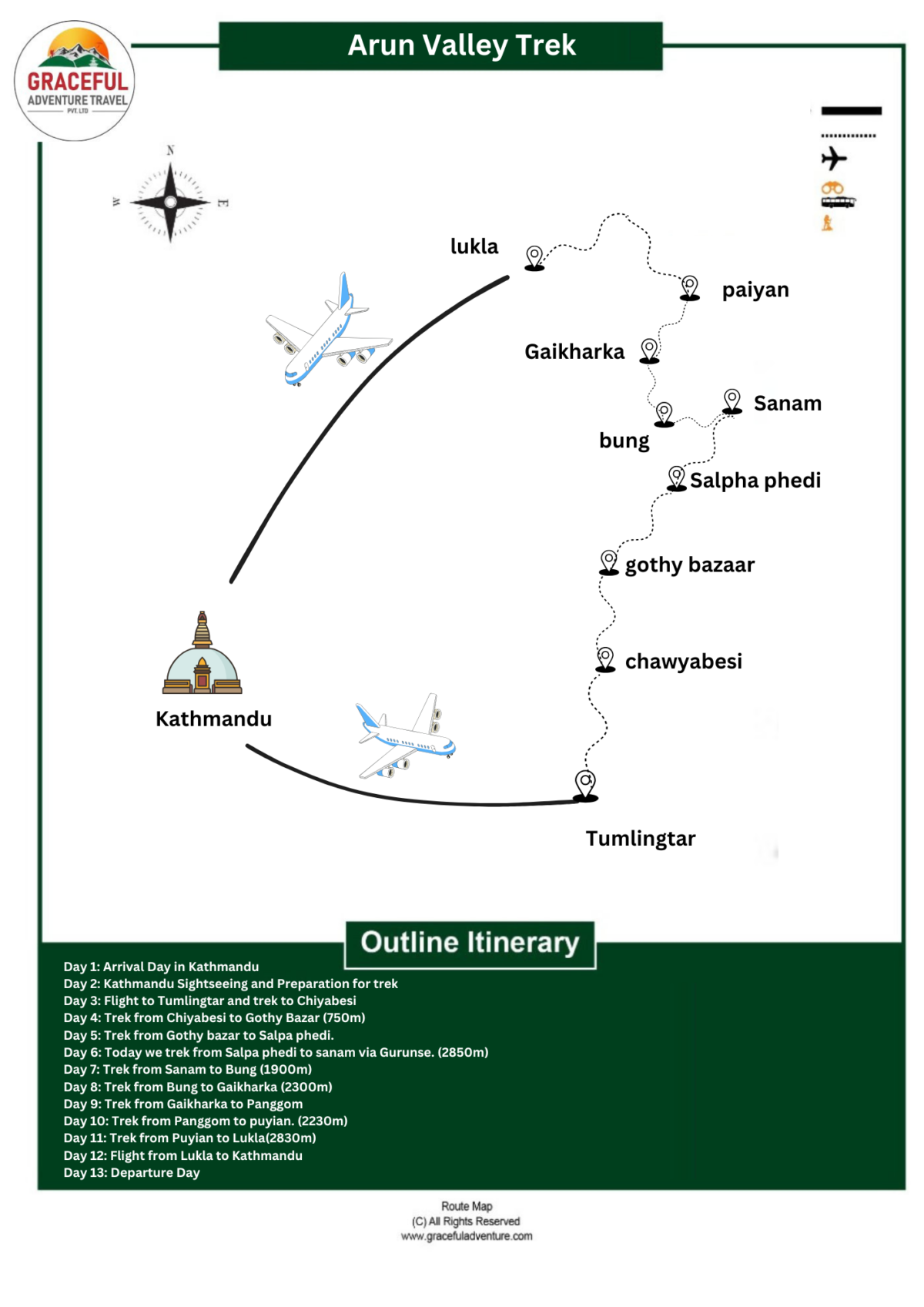
Trip Map of Arun Valley Trek
Arun Valley Trek - Trip Information
What makes Arun Valley Trekking Special?
Arun valley trekking provides spectacular views of Everest, Mera Peak, Makalu, Amadablam, and other Himalayan ranges. Arun valley is best destination for those who wants to be close to nature and watch endangered species of plants, animals, birds and butterfly which can found in this area. More than 600 species of bird and 800 unique species of Butterflies are found in this valley which makes popular in Nepal. Arun Valley is the deepest valley (8391m) in the world. Trekkers can trek through isolated valley and rhododendron forest.
Essential materials Equipment
Comfort in the Himalayas trekking is properly to be equipped with all requirements, which assure comfort, safety, and an enjoyable trip. This includes sturdy quality trekking boots, multi-layered appropriate clothes to wear, a waterproof and windproof jacket that protects from uncertain mountain weather, a good backpack to carry personal things, while a day pack would carry your water bottles, snacks, and any essentials easy to reach. Also, don’t forget trekking poles for stability on uneven terrain, a hat, gloves, sunglasses for sun protection, and a headlamp if it’s low light.
Other things one might want to pack include a sleeping bag, a refillable water bottle with water purification tablets, and personal toiletries. If you are going to be using luxury accommodations, most of them have basic amenities, but it is always prudent to pack in light toiletries and a power bank for charging your devices. With proper preparation and the right equipment, any trek becomes enjoyable and hassle-free to take in the beauty of the journey.

Arun Valley Trekking Difficulty Level
Arun Valley trek difficulty lies in between easy to moderate trek according to one’s strength and enduring capacity. Though this trek doesn’t demand extra physical fitness, you should not be suffering from knee or ankle problems alongside heart and lung disease. Trekkers should be mentally and physically able for Arun Valley Trek.
This trek is completed by 5-7 hours of walking per day having enough breaks in between. It’s better to prepare for this trek with adequate exercise and fitness 1-2 months prior to the trek date.
Food and Accommodation at Arun Valley Trek
Food and accommodation are the priorities for every traveler during their Arun Valley Trek. Arun valley lies in the rural part of the country and the 5 stars hotel or the best food and lodging cannot be achieved. However, there are excellent lodge houses and hotels. The hotels are mostly twin sharing and the single bedroom can be managed upon your request.
Food is essential during the trek. Burning of food is the essence of energy to achieve this trek. There’s a saying in Nepalese “Dal Bhat power, 24 hours” meaning the dal bhat gives you the power to withstand for almost a day. The national cuisine is dal bhat however other foods such as momo, noodles, soups,and other local dishes curries, lentils, and vegetables can be prepared upon your wish and request.
No traveler must worry about their food as we prepare a detailed list of your taste and include it in the hotel and place of your stay during the Arun Valley Trek.
We had selected the best hotels during the trek where we provided standard meals of the day as breakfast, lunch, and dinner. We may however provide you with complimentary tea and coffee occasionally. We highly encourage you to drink green tea, hot or warm water, and coffee and want you to be fully hydrated during the course of the trek.
We strongly encourage you to avoid hard drinks and highly caffeinated drinks and dairy products as they may cause difficulties in higher elevation to your physiology and health.
Best Time to Visit Arun Valley
Autumn is considered the best season for Arun Valley Trek. In this season the weather remains clear with blue skies and green forests. In Nepal Autumn falls from late September to early November. The clear weather will offer you amazing views of the mountains. The Nepalese major festivals: Dashain and Tihar also lie in this season.
Spring which falls from Late February to early April is also another best season for the Arun Valley trek after Autumn. No fluctuation in weather with adequate temperature makes this season excellent. The Nepalese major festivals: Dashain and Tihar also lie in this season. During the trek you can see varieties of Rhododendron, green forest and it gives astounding views of mountains with blue skies.
The period between late November to early February is not preferred as it is the winter season and has the harshest cold. The most casualties heard occur during this season.
Similarly, the monsoon season arrives June to August in Nepal. The heavy rain and landslide make travel difficult. If you want then you can go for trek but do not expect great weather and mountain views.
Tipping During the Trek
Tipping is your own choice of presenting the gratitude for your services and within your discretion. You may wish to tip for the services you like or just say “DHANYABAD” in Nepali terms to show your immense gratitude for the service.
Tipping is usually offered on the final day of the trip. Similarly, trekkers can tip to the hotel, lodge or people on any day they like. The amount of tipping is entirely upon personal choice and perception.
Altitude Sickness and Acclimatization
When the elevation is above 2000m from the sea level AMS (Acute Mountain Sickness) symptoms can be seen due to less oxygen in the atmosphere, which will make breathing difficult. Dizziness, Headache, Fatigue, Nausea are the symptoms of AMS.
The elevation of Arun Valley trek is not high. Though there is less chance to get altitude sickness. You should walk slowly and steadily to let your body get used to the thin air. If you try to walk fast and cover high altitude in less time, there are chances to get AMS. Precaution should be used to keep conditions from worsening. Drink Plenty of water which keeps the body hydrated and have balanced diet food that can energize your body.
We haven’t mentioned acclimatization in itinerary. In case if you need acclimatization then we’ll manage for you according to your health condition.
Travel insurance
For Arun Valley Trek good travel insurance policy is very important which offers suitable coverage for all your activities. Anything can happen during the trip. Though we are more conscious about safety, sometimes we cannot rule out mishaps and emergencies which can occur at our destination.
Your travel insurance policy should cover physical injuries, helicopter evacuation, hospital expenses, and any other emergencies that you can face during trekking.
Drinking Water at Arun Valley
Drinking Water is very essential for trekkers to keep the body hydrated and prevent AMS (Acute Mountain Sickness). During Arun valley trekking one should consume 3-4 liters of water in a day.
We highly recommend you to carry one reusable water bottle with you which can hold hot water rather than buying bottled water. Bottled water can be expensive in trails and also it can add thrashing problems in Trekking area. You can use water purification tablets to purify water. But the taste will be different after using tablets. Always try to drink water after purification and proper treatment. Boiled water is available at the teahouse with additional cost.
Entrance Permit and Requirements
The permits that you need for
1. Sagarmatha National Park Entry Permit
2. Khumbu Rural Municipality Entrance Permit.
3. TIMS (Tourist Information Management System)
Important Documents and Information to get these permit
• 2 passport size photos
• Photocopy of your passport
• Dates when your trek starts and end
• Emergency Contact Information
• Travel Insurance Detail
Frequently Asked Questions
Arun Valley Trek Lays in eastern Nepal, which is a newly developing trekking area with very fewer trekkers. The Arun valley trek offers brilliant views of Everest and Makalu.
It’s moderate to challenging trekking as there is steep up and down for which good physical fitness is required.
The best seasons are spring-March to May-and autumn-September to November-for clear skies and good weather.
Normally, it’s an approximate 15-20-day trek; however, it depends on your itinerary and acclimatization schedule.
Yes, you need the entrance permit to Makalu Barun National Park and a TIMS card for this trek.
Teahouses and lodges provide services along the route. However, some of the remote areas require you to camp out.
The local teahouses provide Nepalese dal bhat along with Tibetan and some basic Western meals.
Yes, this trek rises so high that acclimatization should be well implemented to avoid altitude sickness.
It is, in fact, and one of the least touristic trails in Nepal, for those seeking solitude and nature.
Panoramic views of Everest, Makalu, and Baruntse, a variety of wild animals, the Arun River valley, and culturally very rich.
It is advisable for trekkers who have some experience earlier because it contains steep and remote terrain.
Price Starts From
US$ 1465
-
1 person
US$ 1465
-
2 -
5 person
US$ 1315
-
6 over
9999
US$ 1245
US$ 1465
Need Help?
Ask to Travel Expert
Reviews


-
Price starts
US$ 1465
✖
Talk To Expert

Mr. Padam Timilsina
Travel Expert
Custom vacations, perfectly planned to fit your wishes.
Request for Assistance ⮞