Registration No.:
137081/072/073


ANNAPURNA I EXPEDITION


Trip Difficulty
Challenging

Max. Altitude
8,091m./26,545ft.

Meal
kathmandu - BB plan & Trekking - BLD

Accommodation
4* hotel in Kathmandu & Teahouse/Tent on Trekking

Trip Duration
42 Days

Group Size
2-12 People
Price Starts From
US$ 31500
-
1 over
9999
US$ 31500
US$ 31500

Need Help?
Ask to Travel Expert
Trip Highlights
- First Ascent: Attained by Maurice Herzog and Louis Lachenal on June 3, 1950, a record-breaking feat.
- First 8,000m Summit: First 8,000-meter summit to be attained, a mountaineering milestone.
- Severe Challenges: Repeated avalanches, difficult pitches, unstable weather make it dangerous.
- No Set Route: It does not have a set route due to changing situations and dangerous terrain.
- Death-to-Summit Ratio: Highly fatal 8,000-meter summit, with high percentage of fatalities.
- Winter Ascent: Jerzy Kukuczka and Artur Hajzer’s first winter climb in 1987.
- Prominent Climbers: Ueli Steck and Reinhold Messner are famous for their ascents.
- Dangeous Terrain: Dangeous terrain with ice walls and crevasses, even for experienced climbers.
- Annapurna Base Camp: A trekker’s paradise with excellent view without the danger of the summit.
- Annapurna Conservation Area: In Nepal’s biggest protected area, a hotspot for biodiversity.
- Extreme Altitude Hazards: With extreme altitude, there go extreme dangers of altitude sickness.
- Unpredictable Climbing Conditions: Uncertain climbing from unforeseen climatic conditions, i.e., blizzards.
- Limited Rescue Options: Remote location with rescues becoming difficult to enact.
- Historic Significance: First 8,000-meter peak to be climbed, still challenging for mountaineers.
Introduction of ANNAPURNA I EXPEDITION
Annapurna I expedition is the highest peak of Annapurna region, which was also the top 10 tallest mountain in the world and top 8 tallest mountain in Nepal. This 8091 m standing mountain lies in the Annapurna massif comprising of major 6 peaks as Annapurna I, Annapurna II(7937m), Annapurna III(7555m), Annapurna IV(7525m), Gangapurna(7455m), and Annapurna South(7219m).
Annapurna I is derived from two Sanskrit words ‘ANNA’ and ‘PURNA’ which translates as ‘full of food’. Thus this peak is considered as Goddess of harvest and in Hinduism it is considered as Goddess of fertility agriculture and personification of Goddess Durga. It lies in the first and the largest (7269 sq.km) conservation area of Nepal. This astounding natural serene is separated by Dhaulagiri massif by kali Gandaki gorge and is considered as peaceful and quiet Himalayan beauty of Nepal.
Annapurna I was first sum mated by French expedition team led by Maurice Herzog in 1950. This was the most climbed highest mountain 3 times until 1953 when Everest was first expedited and flow increased. This massif was remain untouched for nearly 20 years when it then summated by British Expedition team followed by southwest. The location of the summit is identified as 28*35’45″N83*49’20″E.
Annapurna I is the least climbed and most challenging peak in the world. Being the top 10 highest peak but the first very 8000m peak, summit can be attempted without use of oxygen. This peak is however little technical to climb and requires experienced level mountaineering skills to ascend the peak. This peak is ski able and adventurous for witnessing the great Himalayan vista.
Annapurna I peak summit is done through trekking in the western part of rural Nepal where trip offers unmapped trails, pristine nature, picturesque mountain ranges, diverse flora and fauna where you will move past through blossoming rhododendron, pine, birch and magnolia forest. Nepal’s geography holds a unique varied landscape in captivating a unique diverse of flora, fauna and terrain with spectacular mix of lifestyle of people. Mountaineering in Nepal is above the “Tree Line Zone” which can be seen as the zone of snow rock and ice. The lure of Himalayas is irresistible as the high ranging altitude provides a best scenario of the harshest climate in the world. The sheer beauty, dramatic massive mountain, best challenging route and the well established hospitality of the people is a sure to go adventure sport in the world.
Annapurna I expedition however requires heavy logistics, communication management, along with trained staffs and guides. The Sherpa people of the Annapurna region have always been experienced to achieve this very height to summit. Annapurna summit requires strenuous level of physical fitness as you have to pass some difficult hurdle and thick layer of ice while ascending. The use of the crampons, ice axes and ropes are most necessary for the ascent.
Outline Itinerary
| Day | Activity |
| 1 |
Arrival day |
| 2 |
Preparation day in Kathmandu |
| 3 |
Kathmandu Valley Sightseeing |
| 4 |
Fly from Kathmandu to Pokhara and drive to Tatopani |
| 5 |
Trek from Tatopani to Humkhola |
| 6 |
Trek from Humkhola to Miristi khola |
| 7 |
Trek from Miristi Khola to Annapurna Base Camp |
| 8-27 |
Summit preparation, acclimatation, training period and Base Camp rotation Period. |
| 28 |
Rest day at Annapurna I base Camp |
| 29-38 |
Annapurna I summit period and get Back to Annapurna I base Camp |
| 39 |
Fly from Annapurna I Base Camp to Dana and rest at Dana |
| 40 |
Drive from Dana to Pokhara |
| 41 |
Drive from Pokhara to Kathmandu |
| 42 |
Final Departure |
ANNAPURNA I EXPEDITION Detail Itinerary
1
Day 1: Arrival day
The welcoming person from our company will be anticipating your arrival at Tribhuvan International Airport. They will be holding a signboard that prominently features the name and emblem of our company, so you can immediately identify them. Any support you may want while traveling will be easily accessible from our representative.
You may be confident that a competent member of our staff will accompany you from the airport to the specified hotel, where you will spend the night. Their knowledge of the region and skills will guarantee a smooth and comfortable relocation.
Our staff member will give you a warm welcome and is dedicated to make your stay as enjoyable as possible. They will be pleased to help if you have any queries or need additional assistance.
Activity: Arrive Kathmandu
Meal: Welcome Meal
Accomodation: 4* hotel
2
Day 2: Preparation day in Kathmandu
Prioritizing both physical and mental preparedness is vital for a peak-climbing trip to be successful. Additionally, it’s imperative to do all required paperwork, which includes getting the Annapurna I Expedition Permit. You may relax knowing that our crew will take care of this process for you by obtaining the permission from the Nepal Mountaineering Association on the second day of our itinerary in Kathmandu.
Today, we’ll concentrate on getting you the necessary climbing gear for the excursion. We will also give you pre-climb training led by our knowledgeable guide, who will arm you with crucial knowledge for a secure and fruitful climb. Their knowledge will be incredibly helpful in preparing you for the difficulties that lie ahead.
Our professional team is totally committed to helping you during the entire process. Every step of the way, we’ll be there to make sure your excursion is both pleasurable and unforgettable.
Activity: Preparation day at Kathmandu
Meal: BB
Accomodation: 4* hotel
3
Day 3: Kathmandu Valley Sightseeing
Welcome to Kathmandu, a historic city in Nepal renowned for its thriving culture, fine art, and stunning architecture. We have a fascinating schedule prepared for you today as you go to discover the Pashupatinath, Swayambhu Nath, Boudhanath, and Kathmandu Durbar Square UNESCO World Heritage Sites. You will be amazed by the cultural and historical riches found at these locations.
We recognize the value of your preparation for the approaching experiences in addition to the study of these wonderful sights. We will help you with any essential purchases and lodging arrangements in Kathmandu today. Our committed team will go above and beyond to satisfy your needs since your comfort and pleasure are our top concerns.
If you have any preferences, whether they be for accommodations, dietary needs, or other special requests, please don’t hesitate to let us know. Our goal is to make sure that your time in Kathmandu is pleasurable and catered to your needs. We’ll do this to get you ready for the activities ahead and make your trip as memorable as we can.
Activity: Explore Kathmandu
Meal: BB
Accomodation: 4* hotel
4
Day 4: Fly from Kathmandu to Pokhara and drive to Tatopani
After a sumptuous breakfast, you will leave the busy city behind and board an early-morning flight from Kathmandu to Pokhara. You will be treated to breath-taking vistas of the lush landscapes and spectacular Himalayas of the Annapurna Himalayan Region throughout the beautiful flight. You will arrive at Pokhara’s domestic airport in safety after around 25 minutes of this thrilling experience.
Before moving on to Dana from Pokhara, you will get an opportunity to have a delicious lunch. The following phase of the journey is a relaxing 4-to-5-hour jeep ride where you may take in the stunning scenery along the route. You will travel from Pokhara to Dana and spend the night there at a homestay.
Activity: Fly to Pokhara & Drive to Tatopani
Meal: BB
Accomodation: Homestay
5
Day 5: Trek from Tatopani to Humkhola
Start trekking from Tatopani, which is known for its natural hot springs. Trek on the trail of the Kali Gandaki River amidst scenic views. Cross through villages and lush green forests in between. The trail becomes steep, with steep slopes in between. Cross suspension bridges over thudding rivers and narrow tracks. Arrive at Humkhola, a serene overnight camp.
Activity: Trek to Humkhola
Meal: Breakfast,Lunch & Dinner
Accomodation: Camping
6
Day 6: Trek from Humkhola to Miristi khola
Begin early in the morning with a steady uphill walk from Humkhola. The trail goes through dense forests and boulder fields. Walk along streams and waterfalls, enjoying the refreshing breeze. Cross high-altitude areas with breathtaking views of the mountains. Some sections are tough, and one has to walk carefully. Arrive at Miristi Khola and camp here overnight.
Activity: Trek to Miristi Khola
Meal: Breakfast,Lunch & Dinner
Accomodation: Camping
7
Day 7: Trek from Miristi Khola to Annapurna Base Camp
Make the final trek to the Annapurna Base Camp. The trail becomes steeper and steeper as you ascend to higher altitudes. Walk over the alpine meadows and glacial landscape. Get a chill in the biting air wind when you reach heights with panoramic views. After hours of trekking, reach the famous Annapurna Base Camp. See the magnificent view of Annapurna and other mountains.
Activity: Trek to Annapurna Base Camp
Meal: Breakfast,Lunch & Dinner
Accomodation: Camping
8-27
Day 8-27: Summit preparation, acclimatation, training period and Base Camp rotation Period.
The first day of your real Annapurna I expedition is day six of the trek. One should be well-trained and prepared for every eventuality that may arise during an adventure at a greater altitude than 8000 meters. Therefore, he or she has to be adequately taught and acclimatized.
During the trip, we will spend 19 days getting ready and acclimating. As part of our training, we will rotate through Base Camps I, II, and III while taking the necessary time to recover and acclimatize. Throughout the rotation period, our guide will instruct you on how to use the equipment and how to climb. The period of 19 days will be crucial and helpful.
Activity: Preparation & training day at base camp
Meal: Breakfast, Lunch & Dinner
Accomodation: Camping
28
Day 28: Rest day at Annapurna I base Camp
After completing base camp rotation period, 28th day will be resting day at Annapurna I base camp. Before embarking Annapurna I summit, you will do proper rest and acclimatize on Base Camp. Today restore the energy and stay camping at Base Camp.
Activity: Rest day at Annapurna I Base Camp
Meal: Breakfast, Lunch & Dinner
Accomodation: Camping
29-38
Day 29-38: Annapurna I summit period and get Back to Annapurna I base Camp
It will be your time to reach the peak of Annapurna I from the 29th to the 38th day. You will climb Annapurna I throughout this nine-day timeframe. You can see the vast and snow-covered Annapurna Massif, Dhaulagiri, Machhapuchre, and other mountains from the summit of Annapurna I. You will return to Annapurna I Base Camp and spend the night camping there after creating some memories and documenting them.
Activity: Climb to Annapurna I & back to Annapurna I base Camp
Meal: Breakfast, Lunch & Dinner
Accomodation: Camping
39
Day 39: Fly from Annapurna I Base Camp to Dana and rest at Dana
After doing proper rest, you will have breakfast and start cleaning base camp where you camp. Pack your belonging and fly back to Dana from Annapurna I Base Camp. And stay cozy night at homestay in Dana.
Activity: Fly to Dana & Rest day at Dana
Meal: Breakfast, Lunch & Dinner
Accomodation: Homestay
40
Day 40: Drive from Dana to Pokhara
On 40th day leaving behind Dana and putting forest and Annapurna Massif at the background, you will drive back to Pokhara and stay the night near to the Phewa Lake in Pokhara Lake side.
Activity: Drive back to Pokhara
Meal: BB
Accomodation: 4* hotel
41
Day 41: Drive from Pokhara to Kathmandu
After having early breakfast, you will take luxurious tourist bus from Pokhara and drive back to Kathmandu. The drive takes 5 to 6 hours. You will have lunch on the way. When you arrive at Kathmandu, you will be taken to your hotel. And then your Annapurna I expedition journey end. Today stay the night in cozy hotel in Thamel Kathmandu.
Activity: Drive back to Kathmandu
Meal: BB
Accomodation: 4* hotel
42
Day 42: Final Departure
You have the fantastic chance to indulge in some shopping in Kathmandu on your departure day, which also happens to be the 42th day of your trip, particularly in the bustling district of Thamel or any other favourite site of your choosing. Rest assured that our firm will handle the transportation arrangements to make sure you get at the airport in plenty of time for your planned departure.
We value your pleasure and are prepared to help you in any way we can, whether it involves changing your itinerary or responding to any further inquiries you may have. Our goal is to make your experience better overall and more memorable.
Activity: Fly back
If our standard itinerary doesn't fully meet your needs, we are happy to tailor it to your specific preferences and requirements.
Includes and Excludes
What’s Included?
- Airport pickup and transfer to your lodge in a private jeep or car.
- Kathmandu International Airport escort by Graceful Adventure Travel staff on arrival and departure.
- 4 nights lodging in Kathmandu (5-star category) with breakfast.
- Experienced and government-licensed high-altitude trekking and climbing guides for the trek and climb period.
- All the trekking and climbing equipment like kitchen tent, store tents, dinning tent, toilet tent, tables, chairs, and kitchen utensils for camp base and camp two.
- Normal climbing equipment like fixed ropes, ice picks, ice pits, snow bars, etc.
- Base camp cook and assistant cook and one cook at camp two.
- Breakfast, lunch, and dinner at local tea houses, hotels, or lodges during the trek.
- Base camp and Camp Two breakfast, lunch, and dinner.
- Staff and trekker fuel and food for base camp and higher camps.
- 60kg baggage allowance of yaks or porters per person to transport to base camp.
- Weather forecast on a daily basis from a Seattle-based company.
- Expedition permits such as the Annapurna Conservation Area Permit.
- TIMS card (Trekking Information Management System) to trek.
- Government charge for expedition royalty and climb permit of Annapurna I.
- One certified, licensed, experienced Everest summiteer guide per member and one Sherpa.
- Trekkers’ and members’ staff’s wages, equipment, medical, and accident cover.
- Base camp medical advisory services including the use of the HRA clinic.
- Equipment allowances and compensation of Climbing Sherpas.
- Equipment allowances and compensation of cooks and kitchen boys.
- Equipment allowances and compensation of the Government Liaison Officer.
- First aid kits for use by staff and members.
- Satellite phone for communication at US$ 3 per minute.
- High altitude provisions for members as well as the staff climbing at base camp and above.
- Dynamic and fixed ropes to be used during the climber’s phase of the expedition.
- Heater in base camp dining tent to warm everyone up.
- Emergency oxygen, masks, and regulators on rent on the spot on orders.
- Individual tent per expedition member at Annapurna Base Camp.
- Solar panels for lighting as well as for battery charging.
- Member and staff tents at Camp 1, 2, 3, and 4.
- Icefall fees as regulated by the Sagarmatha Pollution Control Committee.
What is not Included?
- Lunch and dinner at Kathmandu (except farewell dinner).
- Any drinks, packed lunch, beverages (e.g., energy drink, mineral water, spirits), or chocolates on trekking.
- Laundry, tips, and sundries like personal items.
- Miscellaneous charges incurred due to factors such as natural disasters, strikes, political instability,etc.
- Any means of transport other than specified in the itinerary.
- Any additional staff other than the itinerary.
- Rescue operation, repatriation, medical examination, or hospitalization fees.
- Emergency evacuation fee, medical insurance, and travel insurance.
- Satellite phone, landline, walkie-talkies, or internet facility charge.
- Personal mountaineering gear, i.e., clothing, first aid kit, trekking gears, etc.
- Nepalese import duty for importing expedition gear.
- Summit charge for Sherpa guide climb according to Mountaineering Association regulations (at least US$ 1500 per guide).
- All allowances and gifts to trekking and climbing staff and base camp staff.
- Airfare on international flights.
- Nepal entry visa charges (easily available upon arrival at Tribhuvan International Airport – Kathmandu). Visa charges are US$ 30 for 15 days, US$ 50 for 30 days, and US$ 125 for 90 days.
- Any other services, activities, or products not covered in the itinerary.
- Any other item not clearly mentioned in the inclusion.
Trip Map of ANNAPURNA I EXPEDITION
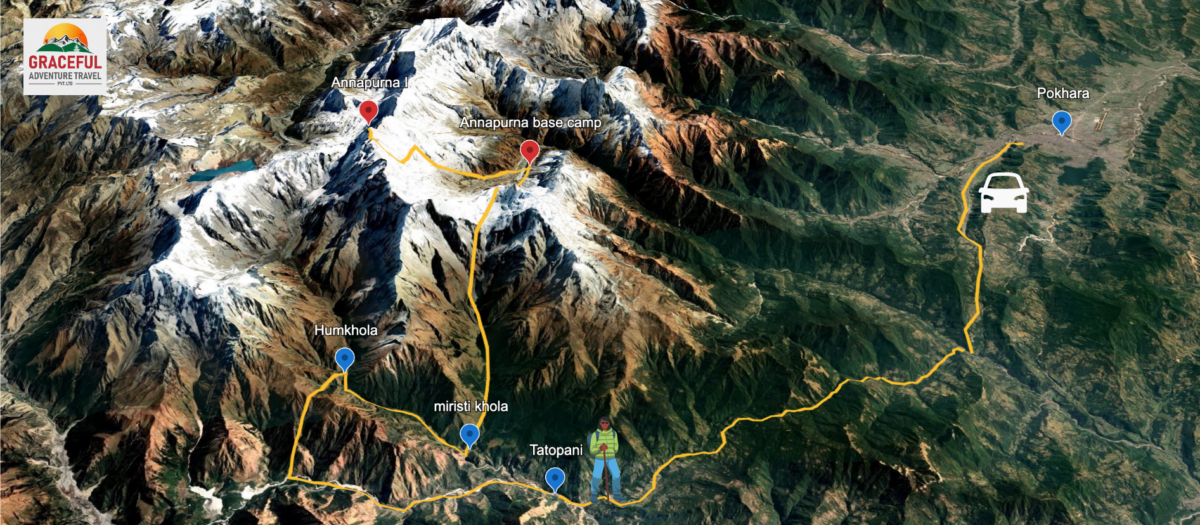
ANNAPURNA I EXPEDITION - Trip Information
Major Attractions of Annapurna I Expedition
Annapurna I Expedition is the most difficult but rewarding climbing achievement on Earth. At a height of 8,091 meters, it is the tenth highest mountain and the first 8,000-meter peak to be ascended. The climb to the summit is full of steep challenge, stunning scenery, and an immense sense of adventure. Due to its high mortality rate and precarious weather, one of the hardest mountains to summit. Despite dangers, the trek itself has a breathtaking view, technical climbs to overcome, and an actual endurance challenge. Technical Climbing and High Death Toll
- Technical Climbing and High Death Toll
Annapurna I is very high on the scale of technicality, near vertical ice walls, and lavish avalanche risk.
Mountaineers have to traverse dangerous ridges and expansive crevasses, which demand top-level mountaineering skills. The deadliest death-to-summit ratio out of all the 8,000-meter mountains is that of the summit, and only trained climbers should dare to try. Sudden blizzards, powerful blasts of wind, and unstable ice are other risk-inducing factors to climb. With uncertain climatic conditions, many expeditions have been forced to retreat unsuccessful as they never had a chance to set foot on the summit. There is a requirement of proper acclimatization, diplomatic preparations, and arrangements in order to ascend this mountain. Panoramic Views and Uninhabited Wilderness
- Stunning Views and Remote Wilderness
Despite its dangers, the trek is rewarded with some of the most stunning panoramas in the Himalayas.
The climb is treated to sensational views of Dhaulagiri, Machapuchare, and the whole Annapurna massif. The climb traverses glaciers, icefalls, and ridges far above the earth, a fantasy. The fact that the area is so isolated guarantees that the climb is serene, and mountaineers are able to experience a deep oneness with nature. The untamed beauty of the Annapurna massif makes it worth climbing for anyone who ever attempts it. Harsh Weather Conditions and Tough Terrain
- Harsh Weather Conditions and Difficult Terrain
The summit is renowned for severe climatic conditions, as the temperature drops far below zero.
The mountain’s topography consists of steep ridges of snow, walls of rock, and treacherous passages of ice, requiring technical expertise. The weather at the summit might render the final part of the ascent very tough at times, and adventurers might need to retreat. There is huge snowfall at regular intervals, causing regular avalanches, and all the expeditions are careful to steer clear of them. Climbing demands physical and mental strength, so one of the most demanding mountaineering experiences on earth. Base Camp and Expedition Logistics Annapurna Base Camp is the beginning of the expedition that has rudimentary infrastructure for the climbers.
- Base Camp and Expedition Logistics
Trekkers and climbers ascend to base camp on a hard and isolated trek through villages, rivers, and forests.
Acclimatization and preparation for the climb take place at base camp. Ascending Annapurna I is an expedition with professional support staff, guides, and Sherpas. With the dangerous risks involved, climbers use fixed ropes, oxygen equipment, and reliable weather forecasts to provide them with their best chances of success.
Route for the ANNAPURNA I EXPEDITION
Annapurna summit is initiated after your arrival in Kathmandu from where you will be transferred to Pokhara via scenic drive. You will then move to Beni via drive. You will then trek to Tatopani, Lete, Thulobogin, Thulobogin pass and finally to Mristi khola. From there you will reach base camp. These days normally take 7 to 8 days based upon your nature to enjoy and sightseeing the major cities of Nepal.
For about 30 to 35 days you will rest and tent from base camp to summit. Your important facilities and needs are considered utmost. The rope ladders and equipment gears will be set up by Sherpa people or guide as needed and seen important. After the day 45 you will follow the trail back to Kathmandu. The preference of your visit to cities can be customizable with proper knowledge and counseling.
Best Season for ANNAPURNA I EXPEDITION
The climate in Nepal can sometime become notorious. The best valued of time and season must be taken care while visiting the harsh and wildest nature of Nepal. The expedition are the highly risk taking adventure in which proper time frame for implementation must be taken care. There are mainly two season famous for operating expedition in Nepal.
Spring season:
Spring is the best season for expedition in Nepal. This includes the month from late February to May month. The climate will be most vivid at this time with the lushly view of the massive mountain terrain. The wind is not harsh and the trail will be less difficult than other season where it is mostly covered with snows. This season has the highest record of expedition in Nepal. The region will be more crowded with people thus the cost efficient travel is most.
Autumn season:
Autumn is another season for the best time to summit the peaks. This season include from the month of late September to early December. The nature is with lushly hills with the vivid sky. The weather will be with less heat haze which includes best spectacular views of the massive peak ranges around the world. This is the second most crowded season of the year. There will be fewer crowds as compared to the spring season.
Winter Season:
Winter is marked by extremely low temperatures, typically below -40°C at higher elevations. Heavy snowfall and strong winds make it perilous to climb, with extremely high chances of hypothermia and
frostbite. The sun rises late and sets early, reducing the climbing window and making it harder. Avalanche risk is high, especially in the aftermath of fresh snow, and renders the climb perilous. Only experienced climbers attempt to climb Annapurna during winter, and successful climbs are rare.
Summer Season:
Summer in Annapurna is characterized by monsoon weather with heavy rainfall, torrential gusts of wind, and poor visibility. The paths are loose and slippery, and climbing is very hazardous. Avalanches are a typical aspect with thawing snow, and this increases the risk for mountaineers. Communication and navigation are tricky with cloud cover and high humidity. Due to such harsh weather, not many climbers attempt to climb Annapurna during summer.
Physical fitness required for Annapurna Expedition
This peak climbing needs strenuous level of physical fitness. This is a grade 5 level of peak climbing thus one must be supposed to be physically fit free from any disability. The climber is supposed to have a well knowledge to use the tools and equipments. The climbers must be in healthiest shape and must endure the harsh wilderness and nature so as to successfully complete this very peak climbing.
Food and Accommodation on Annapurna I Expedition
Food and accommodation is all provided through the package. The stay in the Kathmandu will be of two days where you will stay at hotel based on your level of preference. From then after reaching the Annapurna region you will stay at the tea houses and lodges till to Mristi khola village. From there you will stay on the tent and camp so we will prepare our own food by guide or Sherpa till the final level of ascend and descend till to the Mristi khola village. The days on the camp will normally be 30 to 35 days decided on the basis of your level of fitness and health.
Accommodation at Annapurna I Expedition varies from teahouses at the lower elevations to tented camps at the higher elevations. In the first treks, the climbers reside in basic teahouses with basic beds and common toilets. At the higher elevations, the group settles for tents, which are set in designated high camps. The diet consists of local and high-energy food, including rice, lentils, noodles, soups, and canned or freeze-dried items. Food is cooked by expedition cooks in base camp, but only instant food and energy supplements are available in higher camps to survive on. Proper nutrition needs to be maintained in order to be tough and withstand adverse conditions.
Necessary Equipments
There are many necessary equipment that trekkers have to carry during the treks. During the Annapurna I Expedition trekkers can stay at stars to local level hotels at Kathmandu and Pokhara. On the way they have to stay at local community house or tea house enjoying local cuisine but some places they have to stay on tent doing camping because at upper altitude we can’t find any permanent residence house so that trekkers have to carry necessary equipment and materials according to their stay .The necessary materials needed during the treks are as follows.

A Typical Day in the Annapurna I Expedition
Morning starts early with pre-sunrise breakfast in a normal day at the Annapurna I Expedition, where the mountaineers prepare to ascend on the day. The gradual and steady morning rise is done to acclimatize and save energy. There are some breaks for rehydration, equipment preparation, and weather analysis. Lunch is rapid and taken at a tactical rest point during the ascent prior to continuing to ascend. Afternoon is occupied with ascending ice pitches steep technical rock walls with guides and fixed ropes to provide security. Late afternoon sees the team at a higher camp or descending to a lower level to relax. Night is occupied with hot meals, team meetings, and planning the following day. With little recreation, climbers spend the day checking equipment, looking over the route, or just hanging out in their tents prior to turning in early and sleeping soundly in preparation for the next phase.
Annapurna I Expedition Acclimatization
Since it stands at a height of more than 8,000 meters, there is a need for acclimatization at Annapurna I Expedition. The climb is performed on a graduated slope schedule with regular rotations between the lower and higher camps to enable the body to acclimatize to low oxygen. Signs of altitude sickness like headache, dizziness, and nausea are always watched. Climbers are warned to hydrate with lots of water, healthy food, and plenty of rest. Oxygen tanks and medication like Diamox are never lacking to be used on a preventative basis. Notwithstanding efforts at acclimatization, the inclement high-altitude weather patterns render the expedition a test of physical and mental stamina.
Difficulties of Annapurna I Expedition
Annapurna I Expedition ranks as one of the most challenging climbs in terms of technical difficulty, adverse weather, and prolonged avalanche hazards. The climbers will be compelled to traverse ice walls, rock faces, and crevasses, requiring skill in learning mountaineering techniques.
Fierce winds and zero-degree temperatures are other challenges of the ascent. Risk is high, and planning and route are essential to survival. Physical fitness levels of a high order, tolerance, and experience at high altitudes are all a prerequisite of this ascent. Mental toughness are also required because of the absence of stable ground and long periods of time spent under harsh conditions being the greatest challenge for the mind.
Annapurna I Expedition Permits
Annapurna climbers need to purchase a series of permits. Additionally, there is a Nepal Mountaineering Association (NMA) mountaineering permit and the Annapurna Conservation Area Permit (ACAP). There is even a Trekkers’ Information Management System (TIMS) card that has to be made available for monitoring climbers.
Permits are very costly, and their prices differ based on whether one climbs during the climbing season and how many individuals. Special climbing permits must be reserved by approved agencies, and expedition teams must receive approval from the government in most cases. It is recommended that you book all the permits prior to beginning the expedition so that you do not waste your time.
Electricity and Communication on Annapurna I Expedition
There is barely any electricity throughout the entire expedition, with solar panels or generators in base camp and some high-altitude camps. Electrical equipment can be recharged at base camp but not charged at high altitude. Mobile telephone signals are not present, and signals are present only at low altitudes. Satellite telephones are utilized in the event of an emergency call, and radio communication is utilised by the expedition teams in order to remain in communication with base camp. Expedition crews and climbers must bring power banks and spares for critical equipment since power supplies run low at high altitudes.
Annapurna I Expedition permit Cost
Annapurna Massif is one of the largest Massifs of Nepal where mountains with different altitude are situated ranging from 5500 to 8091 meters from sea level. Mountains like Annapurna I, Annapurna II, Annapurna III, Annapurna IV, Annapurna south, Gangapurna etc. are located in Annapurna Massif. Among this towering mountains Annapurna is one of highest above 8000 meter and standing at the height of 8091 meters.
Many national and international trekkers and climbers are attracted because of its natural beauty and uniqueness. The culture and tradition also added the glory of the region. Annapurna I expedition is newly born destination and also get influx by many climbers and gets more famous in short period. So, to regulate touristic activity and to promote tourism in Annapurna region of Nepal, government of Nepal have implemented the system of permit.
Those who wants to do Annapurna I Expedition must take permit from Nepal Mountaineering Association. While taking permit, the permit cost varies according to the season. Permit costs USD 1800 in spring, USD 900 during autumn and USD 450 during summer and winter.
The route which mountaineers follow during Annapurna I Expedition lies in Annapurna Conservation Area. In Annapurna Conservation Area different rare and endangered flora and fauna are conserved in their natural habitat and this are is also a restricted area for trekkers and travelers. So, before embarking for any kind of touristic activity everyone should take Annapurna Conservation Area Entry Permit (ACAP) as the permission from the government side. It cost USD 30 per person. One can get ACAP from tourism board of Nepal.
Travel insurance
Travel insurance is crucial, especially when participating in risky activities like mountaineering trips. While unforeseeable occurrences like natural disasters, landslides, floods, avalanches, or altitude sickness cannot be controlled or prevented, travel insurance can shield you from the financial ruin they cause in their wake. Travel insurance is especially important while visiting high-altitude areas that are more than 8,000 meters above sea level, where risks are common and difficulties are inescapable.
An appropriate travel insurance plan should cover search and rescue facilities, medical treatment, hospitalization costs, and emergency helicopter rescue services. Before obtaining any travel insurance subscription, we firmly advise completing careful research. It is important to note that Graceful Adventure Travel Pvt. Ltd. does not engage in these types of activities or provide travel insurance services.
Furthermore, you must provide a copy of your trip insurance coverage while requesting an Annapurna I Expedition Permit from the Nepali government. Any expedition must have this paperwork before leaving on its journey.
Please make sure your travel insurance satisfies these requirements for a complete policy.
ATM and Foreign Exchange
Pokhara and Kathmandu do not have ATMs and foreign exchange services but not along the Annapurna I trek. Climbers must hold enough Nepalese Rupees for any unexpected expense before starting the trek. The expedition cost is usually budgeted in advance, i.e., permits, guides, and gear. Since teahouses and remote camps do not have facilities for the exchange of foreign currency, adequate cash must be carried in case of any unexpected expense during the trek.
ABOUT OUR COMPANY
Graceful adventure is a fully licensed and registered travel company of Nepal in recognition by Government of Nepal. We have an elite group of dedicated personnel of administration staffs, trekking and expedition guides, porters, cook and special counselors in our company. We organize the trek and expedition packages to our valued guest all around the globe. Our main intention is providing safe and effective trail to witness Himalayan vista through absolute delicacy.
Our commitment and our work success has made the guest fall into the love of our charm. Our ultimate motto of travelling the best and safe trail has became famous and selected guest with the best knowledge are involved with us. We are committed in providing best facilities available so as to make your trip go successful. We offer various packages with best reasonable prices and help tailor made some customizable packages according to the clients need, expectation and duration of travel. . Hope you will give us opportunity to satisfy you with our best possible services and facilities available.
Route Map

Frequently Asked Questions
Annapurna I Expedition is very demanding and requires technical climbing experience, high-altitude climbing experience, and excellent physical fitness. There is an ice route, avalanches, and extreme climatic conditions.
Best time is spring (March-May) and autumn (September-November). Both the seasons are normal weather, clear sky, and moderate temperature, and therefore climber conditions will be consistent.
Yes, climbers’ permits are a combination of them, i.e., Annapurna Conservation Area Permit (ACAP), climbing permit by the Nepal Mountaineering Association (NMA), and Trekkers’ Information Management System (TIMS) card.
Annapurna I Expedition takes 40 to 50 days, depending on acclimatization, high camp fixing, and summit climbing.
Plain accommodation in dormitories at lower teahouses and plain food. Sleeping in sleeping bags and insulated pads in tented camp at higher camps.
There are basic Nepali and Western teahouses with meals at lower altitudes, full board with cooks at base camp and energy supplement and dried food at higher altitudes.
The greatest risks include crevasses, altitude sickness, avalanches, unpredictable weather, and cold. It is astronomically high in mortality rate relative to any other 8000-meter peaks.
Yes, climbers will be accustomed to 6000-meter high-altitude ascents, high-altitude survival techniques, and technical climbing.
Yes, supplemental oxygen is utilized above 7000 meters for breathing and to combat altitude sickness
Training also includes endurance conditioning, strength training, and acclimatization to trekking at high altitudes, as well as technical alpine climbing practice on fixed ropes, crampons, and ice axes.
Price Starts From
US$ 31500
-
1 over
9999
US$ 31500
US$ 31500
Need Help?
Ask to Travel Expert
Reviews


-
Price starts
US$ 31500
✖
Talk To Expert

Mr. Padam Timilsina
Travel Expert
Custom vacations, perfectly planned to fit your wishes.
Request for Assistance ⮞