


Talk to Expert +9779856019412

Early bird offer for Everest base camp trek - 20% discount for 2026 & 2027.


US$ 23500

Mt. Lhotse standing at an incredible height of 8516m is the world’s fourth highest mountain peaks. Lhotse lies close proximity to Mt. Everest as it is just situated 3 km south from the ridge of south col. This peak literally translates as south summit in Sherpa tongue. This peak lies in the Lhotse massif composed of 3 peaks as Lhotse middle/east (8413m), Lhotse shar (8383m) and Lhotse main (8516m).
The south face of Lhotse is the most technical part of Lhotse summit while this is considered as largest mountain face in the world. It has the steepest face in the world. Even though this peak is summated by passing via the most dreadful region of world; Khumbu glacier, this peak is known as minor eight thousand because it lies just a 610 vertical height from the south col or Geneva spur.
The main Lhotse was attempted heavily but all attempts were failed until 1956. It was first climbed by Swiss national Ernst Reiss and Fritz Luchsinger via west face. The south face was attempted several times but all attempts were failed till 1984 which was first summated by Czech. In 1979 Lhotse shar was expedited by Austrian expediters Seff Meryl and Rolf Walter. The east peak was however unattempted and remained unclimbed till May of 2001, which was then summated by Russian expediters Eugeny Vinogradsky, Sergei Timofeev and their team.
Lhotse expedition encounters many hurdles such as Khumbu icefall, high altitude, avalanches, deep crevasses, harsh weather condition and even ultimate exhaustion.
Lhotse is a lifetime dream of many people but the dream never really comes easy on hand. Lhotse expedition is arduous painful and requires regular stable effort. The journey is difficult as it really is a risk taking job. The logistics, communication, experience, staff plays an important role where ones determination, patience and perseverance is a necessary trait to be developed. Talking about the unique charm, one is willingly take risk so as to achieve something where no regular individual can achieve.
| Day | Activity |
| 1 | Arrival day |
| 2 | Preparation day in Kathmandu Valley |
| 3 | Kathmandu valley Sightseeing |
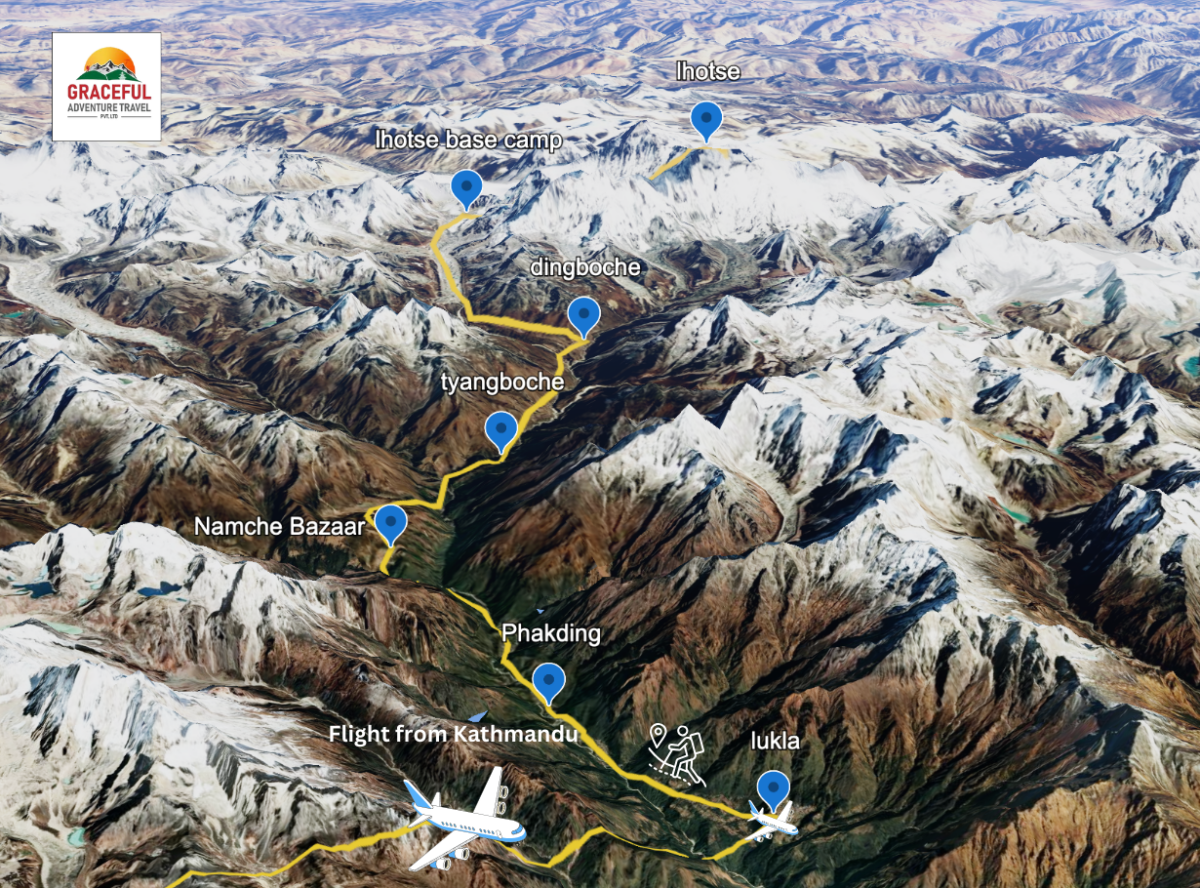
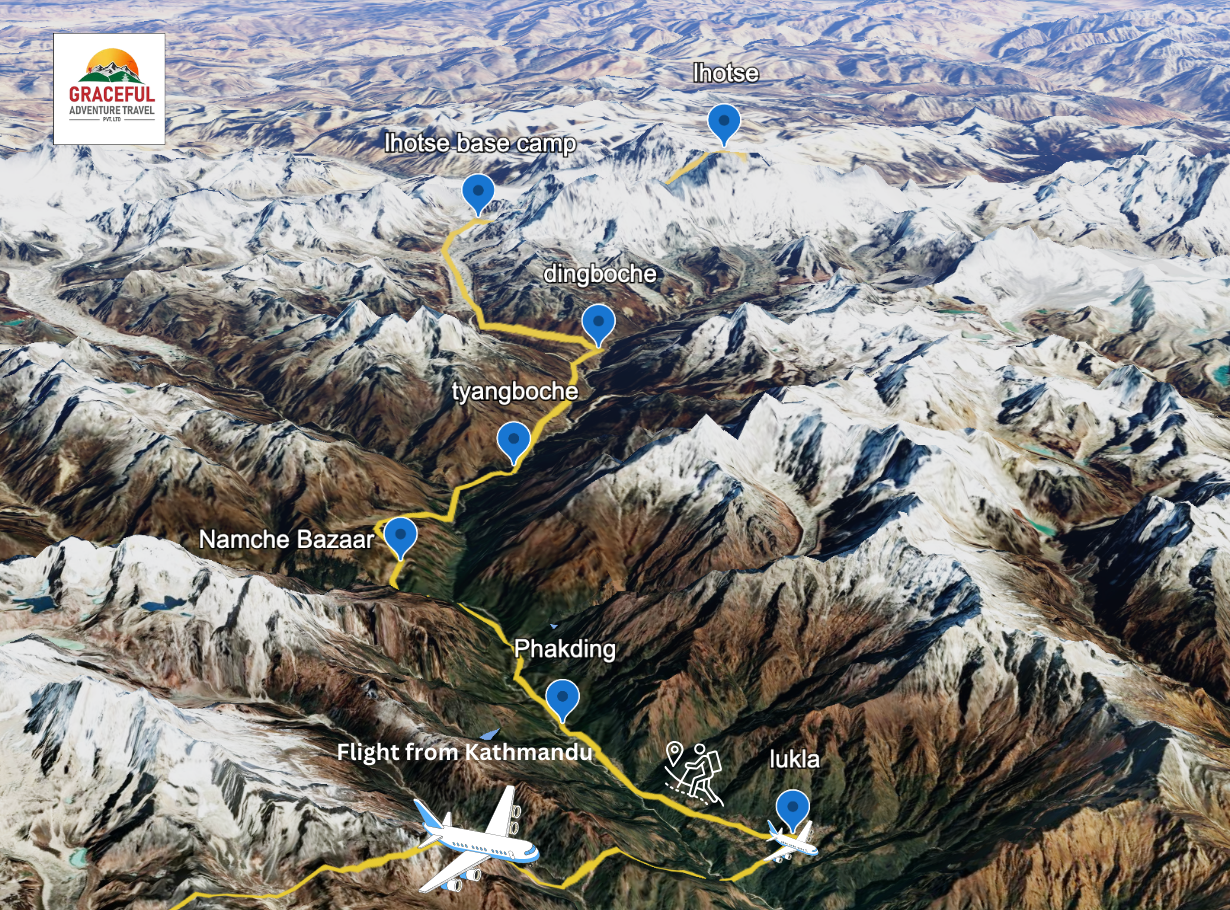
| 4 | Fly from Kathmandu to Lukla and trek to Phakding from Lukla |
| 5 | Trek from Phakding to Namche Bazar |
| 6 | Acclimatization day at Namche Bazar |
| 7 | Trek from Namche Bazaar to Tengboche |
| 8 | Trek from Tengboche to Dingboche |
| 9 | Acclimatization day at Dingboche |
| 10 | Trek from Dingboche to Lobuche |
| 11 | Trek from Lobuche to Lhotse Base Camp |
| 12-44 | Training, preparation, rotation period, climbing period and Lhotse summit and back to Base Camp |
| 45 | Rest day at base camp |
| 46 | Trek from Base Camp to Pheriche |
| 47 | Trek from Pheriche to Namche Bazar |
| 48 | Trek from Namche Bazaar to Lukla |
| 49 | Fly from Lukla to Kathmandu |
| 50 | Departure day |
When you arrive at Tribhuvan International Airport, there will be of our company’s representative holding our company’s board. He or she will pick up you from airport and take you to the hotel for night stay.
Activity: Arrive at Kathmandu
Meal: Welcome Meal
Accomodation: 4* hotel
Before embarking for peak climbing, we need to be prepared physically as well as mentally and further more we need to do some paper work. Before starting our expedition, we have to take Lhotse Expedition Permit. On 2nd day we will take permit from Nepal Mountaineering Association in Kathmandu. Today we will buy some required materials, tools or clothes, food etc. used during climbing. Our guide will give some pre climbing training and much needed information.
Activity: Preparation day at Kathmandu
Meal: BB
Accomodation: 4* hotel
Kathmandu city is one of the historic cities of Nepal which is full of culture, tradition, art, and architect. Kathmandu valley is also listed in UNESCO World Heritage Site. Today you will visit UNESCO world heritage site which include Pashupatinath, Swayambhu, Bouddha, Kathmandu Durbar Square, etc. and prepare for further journey, buy some goods and stay in hotels in Kathmandu.
Activity: Sightseeing at Kathmandu
Meal: BB
Accomodation: 4* hotel
Today after the breakfast take early flight from Kathmandu to Lukla. The flight will be very adventurous over the green hills with the picturesque view of Himalayas above the green line. After flight for 32 minutes, you will reach Lukla. From Lukla trek to Phakding. The trek goes through stone path, rough and ascending. Today stay the night in Phakding.
Activity: Fly to lukla & Trek to Phakding
Meal: Breakfast, Lunch & Dinner
Accomodation: Teahouse / Lodge
Today, you destination will have another beautiful destination i.e., Namche bazar which is also known as commercial center of Khumbu region. You will trek through dense forest of Pine, oak, Rhododendron, etc. You will also trek through Sagarmatha National Park along with wild animals like red panda, snow leopard, musk deer, Himalayan tahr, marten, etc. Opening your eyes and if you are lucky, you will see rare red Panda during the trek. The path is rough, stoney, and stairs and goes ascending through hills and you will reach Namche Bazar and stay in homestay enjoying local culture and foods.
Activity: Trek to Namche Bazar
Meal: Breakfast, Lunch & Dinner
Accomodation: Teahouse / Lodge
To ensure your safety and success during our Lhotse Expedition Program, we prioritize acclimatization at altitudes above 3000 meters. We’ll spend a day in Namche Bazaar, a charming town nestled amidst majestic mountains. Here, you’ll have the opportunity to immerse yourself in Sherpa culture, explore their settlements, and even capture priceless images dressed as a Sherpa. This day of acclimatization not only reduces the risk of altitude sickness but also offers a memorable experience. Let’s embrace the beauty of Namche Bazaar and witness captivating Sherpa cultural performances.
Activity: Rest day at Namche Bazar
Meal: Breakfast, Lunch & Dinner
Accomodation: Teahouse / Lodge
Today the trek will be quite difficult as well as memorable than previous day as we will gain elevation about 1200 meters. The trial is ascending until we reach to beautiful village Tengboche. In Tengboche, we will visit tengboche Monastery, which is very famous. Today we will stay in homestay in Tengboche.
Activity: Trek to Tengboche
Meal: Breakfast, Lunch & Dinner
Accomodation: Teahouse / Lodge
Today we will start the trek towards Dengboche from Tengboche. Trek goes through dense forest of Rhododendron crossing different rivers like Imja River. Walking through ascending path with the view of Ama Dablam which makes to forget all the tiredness and adds more excitement in the trip. Today we will stay a night in Dengboche.
Activity: Trek to Dengboche
Meal: Breakfast, Lunch & Dinner
Accomodation: Teahouse / Lodge
Dingboche, a mesmerizing Sherpa community, showcases awe-inspiring views of mountains like Island Peak and Ama Dablam. This cultural gem, enveloped by breathtaking natural beauty, necessitates sufficient acclimatization before venturing into higher altitudes or embarking on peak climbs. The air density diminishes significantly as you ascend, highlighting the importance of adequate acclimatization measures.
To ensure a smooth transition and minimize the risk of altitude sickness, it is advisable to engage in day hikes around Dingboche, embracing the local culture and interacting with the friendly inhabitants. This allows for a gradual adjustment to the altitude while relishing the remarkable vistas. Enhancing your experience further, spending a night at one of the guesthouses in Dingboche would enable you to fully immerse yourself in the local ambiance.
Activity: Rest day at Dengboche
Meal: Breakfast, Lunch & Dinner
Accomodation: Teahouse / Lodge
Starting from Dingboche, savor a delightful local breakfast before heading to Lobuche. Begin with a two-hour descent, taking in the picturesque scenery. Pause for a refreshing break in Thukla, preparing for the more challenging uphill climb ahead.
Continue your trek, tackling the demanding ascent to Dugla Pass, where limited oxygen adds to the difficulty. Follow the Khumbu Glacier, marveling at its grandeur. Catch sight of the iconic Kala Pathar, offering breathtaking views of valleys, mountains, and natural wonders.
After relishing the awe-inspiring vistas, a short 30-minute walk brings you to the welcoming village of Lobuche. Consider staying at a cozy homestay, enjoying the warm hospitality of the locals. This final stop promises a memorable experience to unwind and reflect on your incredible journey.
Activity: Trek to Lobuche
Meal: Breakfast, Lunch & Dinner
Accomodation: Teahouse / Lodge
From Lobuche we will trek to Lhotse Base Camp after enjoying local breakfast. The trial is decorated by prayer flags. During the trek we can see small monuments and white stupas. After trekking few hours above tree line, we can reach Lhotse Base camp. Explore Base Camp and our guides and porters will set camp there and today it will be the 1st day of camping.
Activity: Trek to Lhotse Base Camp
Meal: Breakfast, Lunch & Dinner
Accomodation: Camp
Before attempting to summit any peak, it is crucial for all climbers to undergo thorough training and be prepared to handle any situation that may arise during the ascent. While pre-climbing training can be done in various locations, it is essential to spend a few days in higher mountain regions to familiarize oneself with the weather, climate, and nature of the mountains. This period allows for proper acclimatization and gaining valuable experience.
To facilitate this preparation, we have allocated a total of 22 days, from the 12th to the 34th day, for comprehensive training and acclimatization, including rotation climbing. The training will involve ascending from the base camp to Base Camp I, Base Camp II, Base Camp III, and Base Camp IV. This duration ensures that climbers become accustomed to the altitude and conditions gradually.
On the 23rd day of the pre-climbing period, a rest day will be observed at Lhotse Base Camp to allow for recovery and rejuvenation. Beginning from the 24th day of the pre-climbing phase or the 36th day of our Lhotse Expedition Program, we will commence the Lhotse Summit attempt. The subsequent 10 days will be dedicated to the actual summiting of Lhotse.
With proper training, acclimatization, and preparation, we will strive to conquer Lhotse. Reaching the summit will reward us with a breathtaking 360-degree panoramic view of the surrounding region, including the majestic Mt. Everest and other renowned mountains above 8,000 meters.
On the summit day, our ascent will commence very early, around 1 am, to maximize safety and ensure optimal weather conditions. We will create lasting memories, capture photographs, and then descend back to Lhotse Base Camp, where we will camp overnight.
By adhering to these standards of preparation and following a well-structured plan, we aim to conquer Lhotse successfully, embracing the challenges and triumphs of the journey.
Activity: Lhotse summit and back to Base Camp
Meal: Breakfast, Lunch & Dinner
Accomodation: Camp
On 45th day of the journey and after successfully conquering Mt. Lhotse, we will do a day rest at Lhotse base Camp. Today we will clean Base Camp and explore the area and have proper rest and stay camping there. It will be the last day of camping in our journey.
Activity: Rest day at Base Camp
Meal: Breakfast, Lunch & Dinner
Accomodation: Camp
Today after having breakfast, we will begin our day descending towards Pheriche. Today the path is descending and the descend will be long as the trial will be rough, stoney and stares through forest. Even though it will be quite easy as the trial will be familiar. After long descend we will reach Pheriche. Today we will stay comfortable overnight in Pheriche and have proper rest.
Activity: Trek to Pheriche
Meal: Breakfast, Lunch & Dinner
Accomodation: Homestay
Today we will gradually descend through dense forest of Rhododendron, Pine, Oak etc. and crossing different streams, rivers and different suspension bridges. Descending with the nature for few hours, we will reach Namche Bazar and stay comfortable night in homestay at Namche bazar.
Activity: Trek to Namche Bazar
Meal: Breakfast, Lunch & Dinner
Accomodation: Homestay
As we descend from Namche Bazaar to Lukla, we are captivated by the breathtaking Himalayan vistas and the lush forests that surround us. Each step we take leaves us in awe of the sheer beauty that envelops us. Upon reaching Lukla, we discover a haven of warmth and hospitality in a charming homestay, where we savor the delightful local cuisine, refreshing drinks, and are treated to captivating traditional performances.
The evening becomes a poignant experience as we take a moment to reflect on our journey, feeling a profound sense of gratitude and cherishing the unforgettable memories we have forged during this remarkable trek. Embraced by the comfort of the homestay in Lukla, we immerse ourselves in a harmonious blend of tranquility and cultural immersion, creating a truly enriching experience.
Activity: Trek to Lukla
Meal: Breakfast, Lunch & Dinner
Accomodation: Homestay
We embark on an enthralling scenic flight, gracefully soaring above lush hills, where we are treated to breathtaking mountain vistas unfolding before our eyes for approximately 32 awe-inspiring minutes. The rugged peaks etch an unforgettable image in our minds. After the flight, we find comfort and tranquility in a charming and well-appointed hotel nestled in the heart of Thamel, Kathmandu.
This cozy sanctuary becomes our refuge as we regroup, meticulously organizing our departure and ensuring a seamless transition from this extraordinary adventure. Using the hotel as our central hub, we attentively make all necessary arrangements, reminiscing about the cherished moments of our journey while eagerly embracing the anticipation of what lies ahead.
Activity: Fly back to Kathmandu
Meal: Breakfast, Lunch & Dinner
Accomodation: 4* hotel
You have the chance to enjoy some shopping in Thamel or any other preferred location in Kathmandu on your departure day, which coincides with the 50th day of your visit. Our company will arrange transportation to the airport, ensuring that you reach there on time according to your scheduled departure. If you have any requests to modify your itinerary or any additional questions, please don’t hesitate to inform us. We are here to provide assistance and make your experience more enjoyable.
Activity: Fly back
If our standard itinerary doesn't fully meet your needs, we are happy to tailor it to your specific preferences and requirements.
The fourth-highest mountain in the world at 8,516 meters, Lhotse is a technical climb with very steep ice walls and daunting Lhotse Couloir. Like much of the Everest climb, the expedition features impressive views of Everest, Makalu, and Nuptse as it guides the climber through Himalayan wilderness terrain. Climbing demands experienced climbing ability because of weather, harsh winds, and avalanche danger. Risk aside, the ascent to the top is well worth it, and Lhotse is a dream for veteran climbers seeking a summit of skill and endurance challenge.
Lhotse standing at 8,516 meters high is the fourth highest mountain in the world and an exceedingly technical climb. It is the path of Everest almost all the way before it takes off at the Lhotse Face, an icy wall that has one of the toughest bits of high-altitude ground. It towers above deep crevasses, icy ground, and rockfall. Blizzards, storm wind, and perilous ice assault without warning, making the climb hazardous. It has to be climbed by skilled and acclimatized, technically competent climbers as lives have been lost while trying to ascend from its harsh weather. Remote Backcountry and Jaw-Dropping View
Despite adversity, the Lhotse climb offers mountaineers some of the best world-class views of Everest, Nuptse, Makalu, and other Himalayan giants. The mountaineers traverse the terrain of Khumbu to known locations such as Namche Bazaar, Tengboche Monastery, and the Khumbu Icefall. The dry rocky surface exposes the mountaineers to nature, which they enjoy about the climb. The route of climbing is made up of glaciers and knife-edge ridges and gives the mountaineers an experience that is thrilling. Harsh Weather and Awful Terrain
Lhotse summit weather is poor, with temperatures as low as -40°C or even colder. Ground has potential ice walls as steep as ridges and technical rock, and the ascent to the summit is radically difficult. Regular high-altitude storms, wind, and regular avalanches are excellent dangers. The most steep and narrow gully beneath the summit, Lhotse Couloir, is the key element of the ascent. It requires only those with physical endurance with gigantic mental toughness to endure Lhotse’s harsh weather. Base Camp and Expedition Logistics
The journey starts with a hike to Everest Base Camp, a procedure that exposes an individual to forests, high-altitude villages, and glacial streams. Climbers acclimatise and train at the base camp before ascending higher. Climbing is facilitated by the use of fixed ropes, oxygen cylinders, and aid Sherpas. Within the unpredictable life of the mountain, the climbers must employ weather forecasts, meticulous logistics, and planning to ensure their chances are as favorable as can be for a successful climb.
Lhotse expedition generally starts from the base camp of Everest (5380m). The expediters fly in to this region via Lukla. And then trek to the base camp via Namche bazaar. The acclimatization is a must as there occur altitude sickness for any new face so it generally takes 8 to 10 days to reach Everest base camp. The goods and materials are carried by yaks, dzo, or human porter needed.
After the arrival to the base camp, expediters acclimatize in this environment for 2 to 3 weeks. They well train their body at this altitude. On the very time, Sherpa or the guide set up ropes and ladder and necessary equipment in place to cross the Khumbu Icefall. Khumbu icefall is regarded as most dangerous and treacherous path so crossing this risky zone as soon as possible is main priority of every traveler or expediter. The entire icefall can fall unto you or you can fall into the crevasses so, it crossing the Khumbu glacier is done at the early morning between 4 to 5 not later than 6 as temperature rises ice defrost and avalanches are most likely to occur.
From there we head for camp 1 located at 6065 meter. Climbers now acclimatize at this location for 2 to 3 days. This is tentatively less chosen location for acclimatization
Expediters move forward to camp 2(6400m) from camp 1 by passing through western CWM. This route is risky as it contains huge deep crevasses. After passing this region, camp 2 is relatively safer and people spend a huge days for acclimatization to this altitude. From here beautiful face of Lhotse is seen.
From camp 2 to camp 3 (7100m), the journey is absolutely tough as you go through harsh climate and intense oxygen deprivation state. You will walk via Lhotse face in the hard ice surface with rope or string attached. This steep climb needs more acclimatization time and expediters spends much time at the camp 3 to acclimatize and to advance for further journey
Camp 4 also known as South Col or separating Geneva spur (7900m) which is reached by passing via yellow band. This region has the well flat surface with loose rock and surrounded by Everest toward north and Lhotse towards south. This is the flat ridge between two mountain peaks. The climbers cluster their camp from one another so as to make its safe and less casualties from wind and hurricane. This is the highest position to which Sherpa carry the oxygen tanks.
Summit of the Lhotse from the camp 4 takes generally 11-12 hours thus this steep climb is all expedited via ropes, ice axes, crampons and necessary equipment. Our Sherpa guide helps fixing all the necessary equipment to make your journey easier.
The climate in Nepal can sometime become notorious. The best valued of time and season must be taken care while visiting the harsh and wildest nature of Nepal. The expedition are the highly risk taking adventure in which proper time frame for implementation must be taken care. There are mainly two season famous for operating expedition in Nepal.
Spring season
Spring is the best season for expedition in Nepal. This includes the month from late February to May month. The climate will be most vivid at this time with the lushly view of the massive mountain terrain. The wind is not harsh and the trail will be less difficult than other season where it is mostly covered with snows. This season has the highest record of expedition in Nepal. The region will be more crowded with people thus the cost efficient travel is most.
Autumn season
Autumn is another season for the best time to summit the peaks. This season include from the month of late September to early December. The nature is with lushly hills with the vivid sky. The weather will be with less heat haze which includes best spectacular views of the massive peak ranges around the world. this is the second most crowded season of the year. There will be fewer crowds as compared to the spring season.
There are many necessary equipment that trekkers have to carry during the treks. During the Lhotse Expedition trekkers can stay at stars to local level hotels at Kathmandu and Pokhara. On the way they have to stay at local community house or tea house enjoying local cuisine but some places they have to stay on tent doing camping because at upper altitude we can’t find any permanent residence house so that trekkers have to carry necessary equipment and materials according to their stay .The necessary materials needed during the treks are as follows.

This peak climbing needs strenuous level of physical fitness. This is a grade 5 level of peak climbing thus one must be supposed to be physically fit free from any disability. The climber is supposed to have a well knowledge to use the tools and equipments. The climbers must be in healthiest shape and must endure the harsh wilderness and nature so as to successfully complete this very peak climbing.
Food and accommodation is all provided through the package. The stay in the Kathmandu will be of two days where you will stay at hotel based on your level of preference. From then after reaching the Khumbu region, you will stay at the tea houses and lodges till to base camp. From there you will stay on the tent and camp so we will prepare our own food by guide or Sherpa till the final level of ascend and descend till to the base camp. The days on the camp will normally be 40-45 days decided on the basis of your level of fitness and health.
Lhotse is World’s fourth tallest mountain lies in Everest region standing at height of 8516 meters. It is also one of the natural treasures of Nepal. Lhotse Expedition is famous for its natural beauty, altitude, and culture and tradition of Sherpa. There is very high influence of mountaineers throughout the year. Due to high influence of visitors in this region also invites the threat for beautiful nature and endangered flora and fauna which are conserved and preserved in their own natural habitat in Everest region of Nepal. Due to large number of visitors, the culture, tradition and heritages are also in danger. Because of its geographical structure and altitude there is also high risk for mountaineers too.
So, government of Nepal had implemented the system of Permit. This helps to manage and regulate all the touristic activities in this region. This helps to preserve rare plants and animals along with the nature and culture and also provides social security to visitors. This permit system also helps to keep the data of trekkers to government.
Those who want to do Lhotse Expedition should take permit from government. Nepal Mountaineering Association (NMA) provides Permit for all expedition or peak climbing. But NMA charges some cost while providing permits. The permit cost varies upon its categories on the basis of altitude. According to the category and season, the price for permit varies. The cost of permit for Lhotse Expedition is USD 1800 for spring, USD 900 for Autumn and USD 450 for winter and summer.
Traveling at extreme altitudes, above 8000 meters, presents numerous life-threatening challenges. The weather can change abruptly in such high regions, making standard forecasts ineffective and posing serious risks. As one ascends higher, the dangers become even greater, making mountain trekking or climbing ventures physically and mentally demanding. Natural disasters like avalanches and landslides loom as constant threats. Furthermore, altitude sickness and frostbite are common health issues that demand immediate medical attention.
Given these perilous circumstances, obtaining travel insurance becomes an essential step before embarking on any expedition or mountaineering adventure. While insurance cannot prevent natural disasters or eliminate risks entirely, it can play a crucial role in potentially saving lives and providing timely rescue assistance. Moreover, it acts as a protective buffer against financial hardships in the face of unforeseen circumstances.
When choosing a travel insurance provider, it is of utmost importance to conduct thorough research and select a reputable company that caters specifically to the needs of climbers and adventurers. An ideal insurance policy should encompass comprehensive coverage for emergency helicopter rescue, medical treatment, and rescue operations.
It’s important to note that Graceful Adventure Travels Pvt. Ltd. is not involved in insurance sales or related activities. Therefore, it is advisable for individuals to independently research and purchase travel insurance from a reliable source before undertaking any adventurous journeys. The right insurance coverage can make all the difference in ensuring a safer and more secure expedition experience.
Graceful adventure is a fully licensed and registered adventure travel company of Nepal in recognition by Government of Nepal. We have an elite group of dedicated personnel of administration staffs, trekking and expedition guides, porters, cook and special counselors in our company. We organize the trek and expedition packages to our valued guest all around the globe. Our main intention is providing safe and effective trail to witness Himalayan vista through absolute delicacy.
Our commitment and our work success has made the guest fall into the love of our charm. Our ultimate motto of travelling the best and safe trail has become famous and selected guest with the best knowledge are involved with us. We are committed in providing best facilities available so as to make your trip go successful. We offer various packages with best reasonable prices and help tailor made some customizable packages according to the clients need, expectation and duration of travel. Hope you will give us opportunity to satisfy you with our best possible services and facilities available.
Lhotse is located in the Himalayas along the Nepal-Tibet border and is connected to Mount Everest through the South Col.
Lhotse stands at 8,516 meters (27,940 feet) and is the world’s fourth highest peak.
The months of April-May and September-October are the best when the weather is most normal.
Lhotse is a very technical mountain that demands high-altitude mountaineering experience, ice climbing experience, and physical endurance to withstand the tough weather.
Lhotse Couloir is an extremely narrow and steep ice couloir to the summit and is a strenuous and technical climb.
Yes, the climbers must possess prior experience above 6,000 meters, technical climb experience, and high-altitude endurance.
The entire Lhotse expedition would take around 6 to 8 weeks, including acclimatization and summit attempts.
Climbers need a Lhotse climbing permit, Sagarmatha National Park entry permit, and a TIMS (Trekking Information Management System) card.
The climb is dangerous for altitude sickness, avalanches, severe winds and subzero temperatures, especially in Lhotse Couloir.
Yes, supplemental oxygen is employed by nearly all climbers over 7,000 meters owing to extreme elevation and lack of oxygen.
US$ 23500
Price starts
US$ 23500

