


Talk to Expert +9779856019412

Early bird offer for Everest base camp trek - 20% discount for 2026 & 2027.


US$ 860

Graceful Adventure Travel, the Panchpokhari Trek, presents a wonderfully tranquil and culturally diverse journey that’s just right for trekkers who like combining the aesthetics of nature, spiritual significance, and adventure at very high altitude without much technical climbing. Located in Sindhupalchok district of Nepal, Panchpokhari (meaning five holy lakes) is situated at 4,100 meters altitude and has very significant religious importance amongst both Hindus and Buddhists.
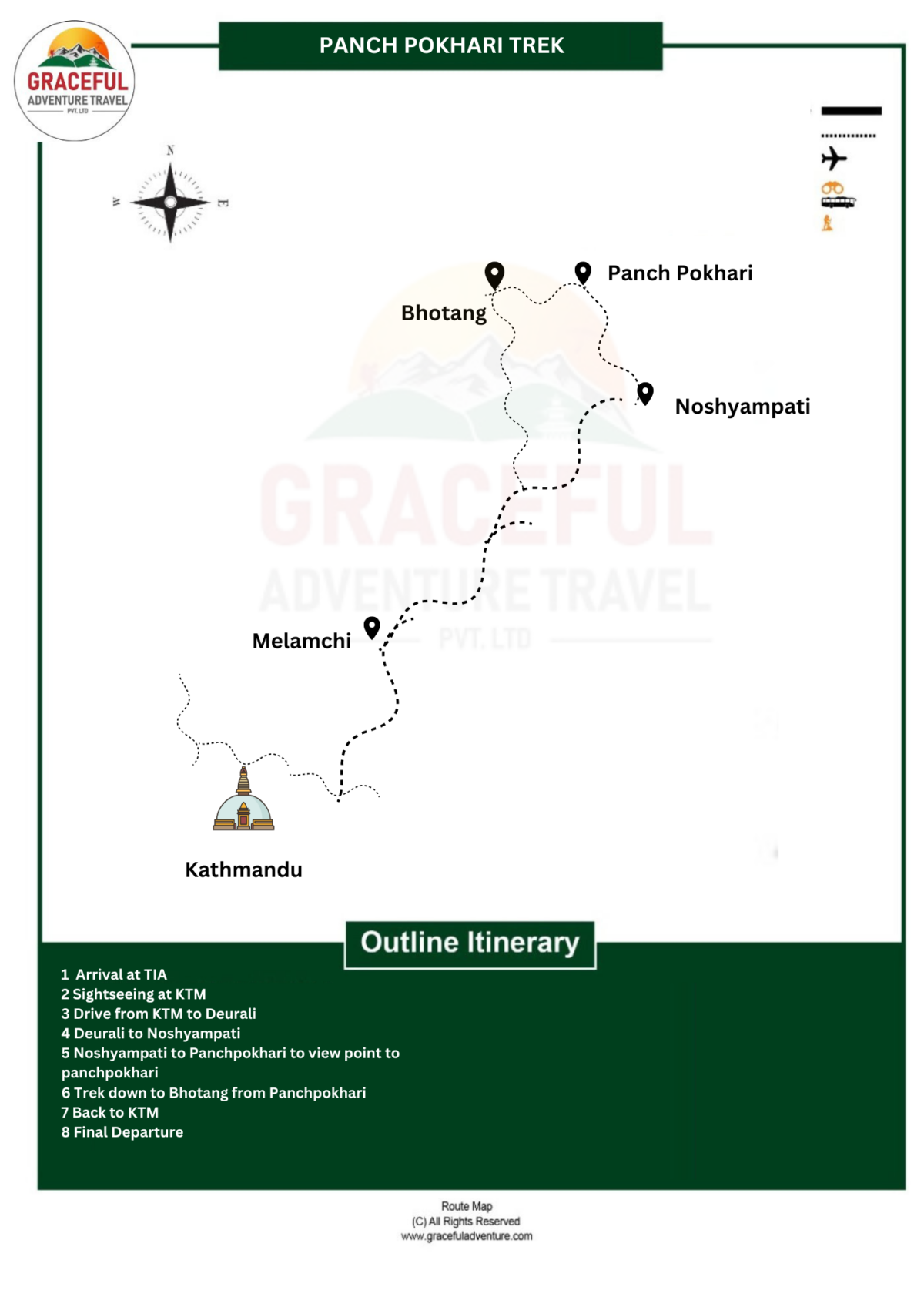
The trek begins in Kathmandu, welcoming the trekkers before their 7-day trip. It spends the next day sightseeing-cum-cultural immersion in the capital before sending the group off through scenic drive towards Deurali, a gradual winding road into the higher altitudes.
The trek becomes alive from Deurali, where the trail ascends through rhododendron forests, alpine meadows, and cute hill villages. Towards the end of the ascent, you will not only be treated to spectacular views of the entire Himalayan range, including slopes of some distant peaks such as Langtang, Jugal, and Dorje Lakpa.
The trek continues on to the main highlight-the lake from that point-onward-the water masses sacredly composed of five glacial lakes. It will be easy to enjoy a breathtaking panorama of the Himalayan range from above the lakes, the perfect location for sunrise views or peaceful contemplation.
Not only because of its natural beauty, but also because it is a spiritual power site, holy waters attract hundreds of pilgrims every year for bathing their rituals during Janai Purnima. Trekkers are going to enjoy more simple monasteries, prayer flags along trails, and local culture of Tamang and Sherpas which is additional dimension to their experience.
Having taken in all the sights, sounds, and charms of Panchpokhari, the group begins the long walk back down towards Bhotang village-most beautifully one last time seeing the calm hills and traditional life of rural Nepal. The group’s return to Kathmandu completes this short but intense journey into pristine nature and hallowed Himalayan landscapes.
The Panchpokhari Trek is good for moderate fitness levels looking for some off-the-beaten-path experience. This trek packs adventure, spirituality, and mountain beauty into one promising trip into one of the lesser-known highlands of Nepal, making it an invaluable addition to any travel itinerary.
Panch Pokhari Trek is a collection of Five Hindu holy lakes which lies in the Sindhupalchowk district of Nepal at altitude of 4100m from the sea level. It has amazing beauty and moreover, inexplicable sceneries. This lake is popular destination for both Hindu and Buddhist Pilgrims. It is the 9th altitude wetland in the world. Each lake has name which decode the Lord Shiva. Panchpokhari is very famous among pilgrims where thousands of pilgrims visit in a year.
Panch Pokhari Trek offers majestic Himalayan views including Dorje Lakpa, Tibetan Himalayan range, Jugal Himalayan range, Gauri Shanker, Langtang Himalayan range, Phurbi Chhyaju. The splendid mountain panorama and very pristine natural beauty along with the incredible wetland attraction make this a must-visit place in remote mountain of Nepal. It also offers the beautiful lakes, caves, Glaciers, Waterfalls and lush green forests.
Graceful Adventure Travel can manage Land transportation according to your preference. We provide experienced Guide and Porter with full knowledge about the destination that ensure safety and ease. Food and Accommodation will also provide according to your preference. Our company will always there with you during trip. You can contact us for any kind of queries and information about the trek.
| Season | Kathmandu (1,300m) | Deurali (2,200m) | Noshyampati (3,700m) | Panchpokhari (4,100m) |
| Spring (Mar–May) | Day: 22–28°C Night: 10–14°C | Day: 14–20°C Night: 6–10°C | Day: 6–12°C Night: -2 to 3°C | Day: 2–6°C Night: -5 to -10°C |
| Summer (Jun–Aug) | Day: 26–32°C Night: 18–22°C | Day: 16–22°C Night: 10–14°C | Day: 8–14°C Night: 2–6°C | Day: 4–8°C Night: -2 to -6°C |
| Autumn (Sep–Nov) | Day: 20–28°C Night: 10–14°C | Day: 12–18°C Night: 4–8°C | Day: 4–10°C Night: -4 to 0°C | Day: 0–4°C Night: -10 to -14°C |
| Winter (Dec–Feb) | Day: 12–20°C Night: 2–6°C | Day: 4–10°C Night: -2 to 2°C | Day: -2–4°C Night: -6 to -10°C | Day: -6–0°C Night: -15 to -20°C |
| Fact | Details |
Tour Name | Panchpokhari Trek |
Maximum Elevation | 4,100 meters (Panchpokhari View Point) |
Duration | 8 Days (Kathmandu to Kathmandu) |
Trek Distance | Approx. 80–90 km |
Difficulty Level | Moderate (Steep ascents, high altitude, no technical climbing) |
Best Time to Visit | April–May, September–November |
Accommodation | Hotels in Kathmandu, Teahouses/Homestays along the trail |
Group Size | 2–10 people (recommended for comfort and support) |
Major Highlights | Sacred Panchpokhari, Himalayan views, cultural villages, serene landscapes |
| Days | Particular (From to) | Time (hrs) | Elevation (m) | Meals |
| 1 | Arrival at TIA | BB | ||
| 2 | Sightseeing at Kathmandu | 1400 | BB | |
| 3 | Drive from Kathmandu to Deurali | 7-8 | 2200 | BLD |
| 4 | Deurali to Noshyampati | 6-7 | 3700 | BLD |
| 5 | Noshyampati to Panchpokhari to view point to panchpokhari | 4-5 | 4100 | BLD |
| 6 | Trek down to Bhotang from Panchpokhari | 2011 | BLD | |
| 7 | Back to Kathmandu | 5-6 | 1400 | BB |
| 8 | Final Departure |
Arrive at Tribhuvan International Airport, which lies in the capital city of Nepal. Our company representative will be there to receive at the Airport with the holding board. You will then escort to the hotel preferred by you.
Activity: Arrive Kathmandu
Meal: Welcome Meal
Accomodation: 4* hotel
Kathmandu valley is famous for its religious monuments where 7 heritage sites (Kathmandu Durbar Square, Bhaktapur DurbarSquare, Patan Durbar Square, Pashupatinath, Boudhanath, Swaymbhunath, Changunarayan Temple) are listed in World Heritage Sites by UNESCO.
Your day starts in the late morning after breakfast. A guide will take you at the historical places and provides detail information about the culture, architecture, monuments, lifestyle of people, festivals. After half day sight seeing you will be driven back to hotel and will be briefed about the trek.
Activity: Explore Kathmandu
Meal: BB
Accomodation: 4* hotel
Today we have to take drive for 5-6 hours from the Kathmandu to Bhotang. Wakeup early in the morning and prepare for the trek. We take breakfast at the hotel then prepare for further packing our goods in our Jeep or Scorpio as you preferred.
At 7-8o’clock we leave hotel for our trip. After driving 3-4hours from Kathmandu we will have our Lunch at Melamchi. Journey continued to the Bhotang. From Bhotang foot trek start with amazing waterfall which is milky white on the way with steep hills. Overnight at Deurali.
Activity: Drive to Deurali
Meal: Breakfast, Lunch & Dinner
Accomodation: Teahouse / Lodge
Today, the trail ascends to Noshyampati. We will take breakfast at deurali. Noshyampati is a 6 hours trek for normal trekker
We will have Lunch at Chittar or Mula Kharka. It’s called(turnip) kharka as a lot of turnip are grown here. Journey continued upward across river and hills with beautiful sceneries. Stayed at Nyoshyampati at local teahouse.
Activity: Trek to Noshyampati
Meal: Breakfast, Lunch & Dinner
Accomodation: Teahouse / Lodge
Heading up from Nyoshyampati to Panchpokhari takes approximately 4hours for normal trekker. We will take breakfast at Noshyampati and continued our trek slowly to Panchpokhari. After 3hours trek to Panchpokhari we will have lunch at tea house. After having lunch we will take short hike to view point.
Activity: Trek to Panchpokhari view point
Meal: Breakfast, Lunch & Dinner
Accomodation: Teahouse / Lodge
Day 6 will be the final day for Foot trek. Early in the morning, we wake you up and will take for a sightseeing. You may take bath in the Panchpokhari.
After that we will take breakfast and initiate our trek downhill. We will follow the same route while descending to Bhotang Village by passing Pineforest, Rhododendron and beautiful rivers.
Activity: Trek to Bhotang Village
Meal: Breakfast, Lunch & Dinner
Accomodation: Teahouse / Lodge
We will take breakfast in Bhotang then loads our goods and materials in Jeep or scorpio. On the way we will take lunch.
From Bhotang we will drive back to Kathmandu to respective hotel.
Activity: Drive back to Kathmandu
Meal: BB
Accomodation: 4* hotel
According to your flight schedule, our company representative will manage everything for you and drop to the Airport. If you have enough time then we will take you for sightseeing where you can do shopping.
Activity: Fly back
If our standard itinerary doesn't fully meet your needs, we are happy to tailor it to your specific preferences and requirements.
Once upon a time, a person called Wurgagba Waiba came here for hunting. He saw lord shiva planting rice. He thought what a foolish person planting rice even in such a snowy area. He went near but then God vanished at the place where the temple is built. It is said that we can see a plough in the waterfall flowing down from here. So, the hunter realized that he had seen Lord Shiva. He didn’t have anything to offer the god except the bell of the dog. Then he offers the bell which can see till today.
Panchpokhari is famous among pilgrims because on the occasion of Janai Purnima thousands of pilgrims visit there. It is believed that if you make a wish with a pure intention then wish will be fulfilled. This place has both religious and cultural importance. The interesting thing about Panchpokhari was that both Hindu and Buddhist devotees plays to their deities in the same place.
Panch pokhari trekking is in the north east of Kathmandu Valley where Tamang, Sherpa, Brahmin, Chettri people are inhabitant who followed Buddhist and Hindu culture. The spiritual people closely connected with the valley offer you the best hospitality you’ve ever experienced.
Panchpokhari Trek is less-tourist trekking trial in Nepal. It takes short period of time and moderate equally rewarding treks in Nepal. Various Flora and fauna can see during this trek. The wildlife includes musk deer, leopard, Musk deer, Himalayan black bear and flora includes Colorful rhododendron, Pine forest
Panch pokhari can reached via two trials. One starts from Sano Okhreni via Chautara. Panchpokhari trek takes average 5-6 hours drive from Kathmandu to reach Chautara. From Chatura our trek begins to Panchpokhari Via Sano Okhreni. After 5days continuous walk, we will reach at Panchpokhari. During 5days we will stay at Kami Kharka, Pauwa Bas, Hille Bhanjyang, Narsim pati, panchpokhari
Another from Bhotang village via melamchi. Most people preferred Bhotang via melamchi because it is comparatively easy and short. From Kathmandu it takes 6hours drive to reach Bhotang, the starting point of the Panchpokhari trek. On the first day we hike up-to Deurali and from Deurali we will trek up to Panchpokhari view point from where stunning views of mountains, waterfalls, lakes can be seen.
Comfort in the Himalayas trekking is properly to be equipped with all requirements, which assure comfort, safety, and an enjoyable trip. This includes sturdy quality trekking boots, multi-layered appropriate clothes to wear, a waterproof and windproof jacket that protects from uncertain mountain weather, a good backpack to carry personal things, while a day pack would carry your water bottles, snacks, and any essentials easy to reach. Also, don’t forget trekking poles for stability on uneven terrain, a hat, gloves, sunglasses for sun protection, and a headlamp if it’s low light.
Other things one might want to pack include a sleeping bag, a refillable water bottle with water purification tablets, and personal toiletries. If you are going to be using luxury accommodations, most of them have basic amenities, but it is always prudent to pack in light toiletries and a power bank for charging your devices. With proper preparation and the right equipment, any trek becomes enjoyable and hassle-free to take in the beauty of the journey.

Food and accommodation are the basic travel requirements of any tourist, which would give the traveler comfort and satisfaction. Since Panch Pokhari is within a remote area, any luxury hotels or high-class accommodations are not accessible; instead, there are well-maintained teahouses and lodges along the way, providing the basic requirement of a comfortable stay. Accommodation on the route includes 10 nights in teahouses and 2 nights in Kathmandu to rest and prepare. The accommodation provided is mainly in twin-sharing rooms. Private rooms will be available upon request, which must be stated at the time of booking. Food plays a very crucial role throughout the journey of trekking.
As Panch Pokhari is one of the strenuous treks with its height reaching up to 4,100 meters, nutritious and high-energy foods are highly necessary. Dal bhat or rice, lentils, and vegetables is the traditional meal of Nepal, and most liked by trekkers because it contains a complete nutritious value. As the saying goes, one Nepali proverb goes, “Dal Bhat power, 24 hours,” meaning in the real sense one plate of dal bhat gives enough energy to long-lasting energy do a trek. Sherpa menu, noodles, soups, curries, momos, lentils, bread, eggs, porridge, and sweets are other some available options for food.
In some teahouses coffee, tea are given along with that some snacks keep you refresh along with keep warmth. We ensure your dietary preference is respected and taken into consideration, and hygienic nutritious meals are provided through the journey. We highly recommend trekkers to take plenty of warm water, green tea, and herbal drinks in order to stay hydrated throughout the high altitudes. Trekkers must avoid alcohol, highly caffeinated beverages, and dairy products as it causes altitude health problems and also dehydrates the body.
Panch Pokhari is a breathtaking trekking destination, but choosing the right season plays a crucial role in experiencing the adventure there. Since the trek reaches over 4,100 meters, weather conditions become highly influential. Though trekking can be performed throughout the year, some seasons give better weather and clearer views for a good journey.
Spring, from March to May, is considered one of the best seasons for trekking in Panch Pokhari. During this time, the temperature varies from 20°C during the daytime to 5°C at night. Rhododendrons color the trails, and the skies are clear with the peaks covered in snow, giving a great backdrop. This season is very suitable for trekking because of its moderate climate and spectacular landscape.
Autumn is another favorable time for trekking in Panch Pokhari, starting from September up to November. It usually offers crystal blue skies, mild temperatures, and beautiful greenery, attracting many trekkers. The temperature is consistent, thus making the trek easier and more enjoyable. Besides that, Dashain and Tihar, major festivals in Nepal, fall in this period and allow travelers to experience vibrant local culture.
June, July, and August are considered the monsoon months, when frequent rain makes trekking tougher with slippery trails and plenty of leeches. But the landscape gets lush and green, and the waterfalls are at their best.
Winter: Winter begins from late November up to early February, and is considered the least favorite time for trekking due to extreme cold, snowfall, and harsh conditions. The temperature falls very low below freezing, making the trek tougher and more hazardous. This is the season to avoid unless well prepared for winter trekking.
This allows you to make your trek much safer and more enjoyable in the right time of the year, while fully appreciating the beauty of Panch Pokhari.
Tipping is your own choice of presenting the gratitude for your services and within your discretion. You may wish to tip for the services you like or just say “DHANYABAD” in Nepali terms to show your immense gratitude for the service.
Tipping is usually offered on the final day of the trip. Similarly, trekkers can tip to the hotel, lodge or people on any day they like. The amount of tipping is entirely upon personal choice and perception.
Above 2,000 meters, the oxygen in the atmosphere is low, and there is a risk of Acute Mountain Sickness. Symptoms include dizziness, headache, fatigue, and nausea. Since Panch Pokhari itself reaches an altitude of 4,100 meters, one should be prepared for altitude challenges.
The secret to avoiding AMS is going at a very slow and steady pace, which enables your body to acclimatize with the thin air. The higher the rate of altitude gain, the greater the risk for AMS; thus, proper acclimatization should be done. Drinking plenty of water, being hydrated, and having the right diet will keep your body able to cope with the altitude.
Our itinerary is inclusive of acclimatization days to lessen the risk of AMS and offer a safer experience trekking. The best recovery options in worst-case scenarios include going down to a lower altitude.
A good insurance policy will come in handy in case any emergencies arise on this Panch Pokhari trek. Though there is a measure of safety precautions taken, there may be chances of accidents, altitude sickness, injury, or bad weather.
Your travel insurance should cover medical emergencies, hospital expenses, helicopter evacuation, and trip cancellations. Having proper insurance will provide peace of mind and financial security in case of any unforeseen incidents during the trek.
Staying hydrated is crucial at high altitudes to prevent AMS and maintain energy levels. Trekkers should consume at least 3 to 4 liters of water per day.
It is highly advisable to carry a water bottle and not buy bottled water for the sake of saving plastic waste that harms the environment. Water from natural sources must be treated either with water purification tablets or filters, although they may affect the taste. Most teahouses provide boiled water for an additional cost, which is the safest option for drinking.
To trek to Panch Pokhari, you will be needing the following permits:
1. Langtang National Park Entry Permit
2. TIMS (Trekkers’ Information Management System) Card
Important Documents Required for Permits
– Two passport-size photos
– A photocopy of your passport
– Trek start and end dates
– Emergency contact information
– Travel insurance details
These are the permits which are important for smooth and lawful trekking in the Panch Pokhari region.
First of all customer should contact with inquiry firm or booking firm or in whatsapp . The company presentative will contact the customer with in 24 hours. After that the company person guides the customer. The company person confirms the booking of the customer then the process is down below :
1. Package Selection:
Start by visiting our company’s website and browsing our trekking packages. You’ll find all the details, including the itinerary, inclusions, exclusions, and prices. If you have any questions, feel free to contact our customer support team, who will be happy to assist you.
2. Personal and Group Information:
Once you have decided to book the package, fill out the booking form on our website with the necessary personal and group information. Please ensure that all details are accurate, as any mistakes or omissions may lead to issues during the trek.
3. Confirmation:
Once you submit the booking form, our company representative will review your information and contact you within 24 hours to confirm your booking. We will send you our standard agreement, which outlines the terms and conditions of the booking. Please read the agreement carefully and ask us if you have any questions.
4. Advance Payment:
To confirm your booking, we require a 20% advance payment of the total cost of the package. You can make the payment through our secure online payment gateway, which accepts all major credit and debit cards. Alternatively, we can send you a payment link or provide you with our bank details for a direct bank transfer.
5. Booking Confirmation:
Once we receive your advance payment and signed agreement, we will confirm your booking and send you a receipt of payment. We will also provide you with a detailed itinerary, packing list, and other essential information to prepare you for the trek.
6. Pre-Trek Briefing:
Before the trek starts, we will conduct a pre-trek briefing, either in person or online, to go over the itinerary, safety protocols, and other relevant information. This briefing is essential to ensure that you have a safe and enjoyable trekking experience.
We hope that this updated booking process meets your requirements and makes it easier for your customers to book our trekking packages. If you have any further questions or suggestions, please let us know, and we’ll be happy to help.
Panch Pokhari is located in the Sindhupalchowk district of Nepal, northeast of Kathmandu. It is a holy pilgrimage site with five holy lakes, lying at an altitude of about 4,100 meters.
The trek is moderately graded. Forests, hills, and villages of the remote areas are to be traversed with some steep ascents. No previous experience of trekking is required but good physical fitness is recommended.
The best time to trek is spring-March to May and autumn-September to November as during this period the weather is pretty clear and provides crystal views of the Himalayas. It’s extremely cold in winter and gets heavy rainfall in monsoon which makes the trails slippery.
Yes, you need the Langtang National Park Entry Permit and the TIMS (Trekkers’ Information Management System) card for this trek.
The basic teahouses and lodges come with twin-sharing rooms. Owing to the development of the trail being at its end, tented accommodations may have to be made in some places.
You can find traditional Nepali food (dal bhat), noodles, soups, momo (dumplings), roti, curries, and seasonal vegetables. In some places, breakfast items like eggs, pancakes, and porridge are available.
As this trek goes 4,100 meters up, the risks of AMS Acute Mountain Sickness are slight. As to prevent AMS, one can walk slowly and be hydrated by having appropriate days for acclimatization days.
The trek could take approximately 7 days to 10 days, depending on how to plan itinerary in pace.
Essentials to bring:
• Warm clothes- thermal layer, down jacket, gloves, hat • Trekking shoes – preferably ankle high rigid boots • Sleeping bag • Trekking pole • Sunglasses, sun protection, and first aid kit. • Water bottle and water purification tablets
Yes, but a reusable water bottle is recommended, along with some purification tablets or filtration system, as this will save on the expense and/or environmental impact associated with bottled water.
US$ 860
Price starts
US$ 860

