


Talk to Expert +9779856019412

Early bird offer for Everest base camp trek - 20% discount for 2026 & 2027.



US$ 1080

Sikles trek is an easy short trek that takes you to the largest cultural village north to Pokhara. This fascinating destination is 2000m above and is shadow by Annapurna and Lamjung Himal. Easy to achieve and a lot of delight to offer, this fascinating trek is popular among both national and international tourists. Sikles trek is an easy trek designed for those who seek to visualize some of the best natural sightseeing and enjoy the cultural of highlanders of Nepal.
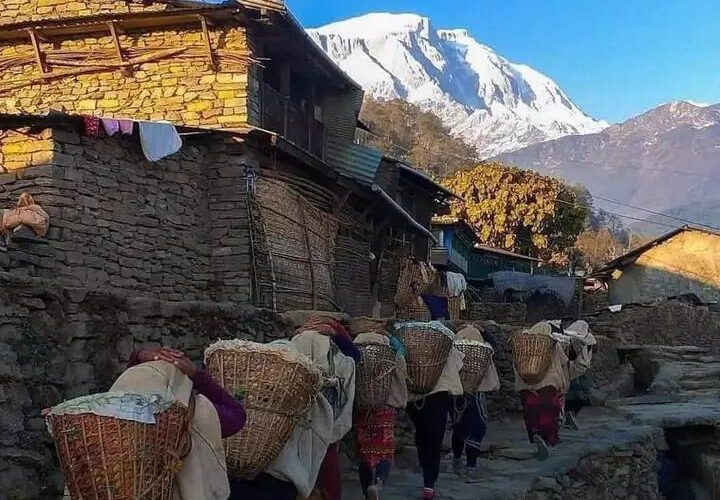
Sikles Trek starts with a scenic flight from Kathmandu Valley all the way to Pokhara (820m). The trek then ascend passing various lush green forest flourished with blooming Rhodendron, various Tamang cultural villages, fascinating sightseeing spot and entire wilderness of peaceful nature. This new trek offers a truly enchanting village experience where we get to see the real rural Nepal. Trekkers can enjoy by camping at unique sites, eat the local dishes and learning the culture and lifestyle of the indigenous.
Along the journey, trekkers will also be rewarded with breathtaking sunrise and sunset views over the snow-capped peaks. The friendly hospitality of the Gurung and Tamang communities, combined with the rich biodiversity of the region, makes this trek a unique and memorable experience. Whether you’re an adventure seeker or a culture enthusiast, the Sikles Trek offers a perfect blend of nature, heritage, and tranquility, making it an ideal getaway for those looking to explore Nepal beyond the usual trekking routes.
Graceful Adventure Pvt. Ltd. is a renowned adventure travel company based in Kathmandu and Pokhara, Nepal. Our dedication to providing exceptional experiences has earned us the admiration of our clients, and we strive to exceed our guests’ expectations. We cordially invite you to join us on our expeditions to explore the magnificence of the Himalayas.
| Day | Activity |
| 1 | Arrival Nepal |
| 2 | Drive from Kathmandu to Pokhara |
| 3 | Drive to Sikles from Pokhara |
| 4 | Trek to Huwu (Hugu) from Sikles |
| 5 | Trek to Kahphuche Lake and back to Huwu |
| 6 | Trek back to Sikles |
| 7 | Drive back to Pokhara |
| 8 | Drive to Kathmandu |
| 9 | Final Departure |
Our company representative pickup from airport and take you to the hotel in Kathmandu. This evening meeting with you and guide and explanation about the trekking.
Activity: Arrive Kathmandu
Meal: Welcome Meal
Accomodation: 4* hotel
After Breakfast Company vehicle is ready on your hotel for sightseeing around UNESCO heritage site in Kathmandu like Kathmandu durbar square, Swayambhunath stupa, Pasupatinath temple and Boudhanath stupa. Our company representative makes a trekking permits document.
Activity: Arrive Kathmandu
Meal: BB
Accomodation: 4* hotel
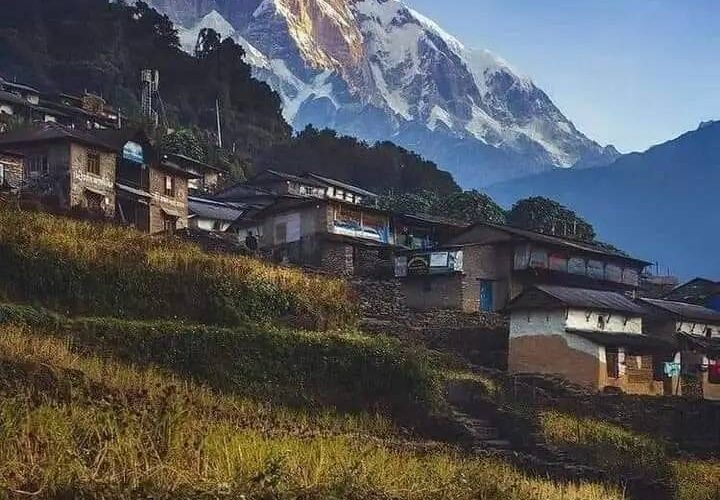
You will start your journey by driving from Pokhara to Sikles, a beautiful Gurung village nestled in the Annapurna region. The drive will offer scenic views of rolling hills, lush forests, and distant mountain peaks. Upon reaching Sikles, you’ll be introduced to the local culture and the serene environment of this traditional village. It is a good point to start your trek, with nearby local lodges and hospitable people. You will be able to relax and acclimatize for the upcoming trek.
Activity: Drive to Sikles
Meal: Breakfast, lunch & Dinner
Accomodation: Guesthouse / lodge
Following breakfast, you will begin your trek to Huwu (or Hugu), a peaceful village at a higher elevation. The trek involves walking through dense forests, fields with terracing, and rolling hills. The view of the surrounding mountains, including Annapurna and Machapuchare, will be more visible as you trek higher up. Upon reaching Huwu, you can overnight in the village and catch a glimpse of the local culture. The peaceful atmosphere makes it an appropriate place to overnight.
Activity: Trek to Huwu
Meal: Breakfast, lunch & Dinner
Accomodation: Teahouse / Lodge
The day’s trekking will take you to the breathtaking Kahphuche Lake, which is renowned for its serenity as much as itspanoramic scenery. The walk will entail crossing all kinds of scenery, from forest to alpine meadows. Take a few minutes here to rest in the serene environment and snap photos of the beauty of this high-altitude location. And then, after a stay near the lake, you will return to Huwu overnight, having time to relax and plan the day’s excursion.
Activity: Trek to Kahphuche lake & back to huwu
Meal: Breakfast, lunch & Dinner
Accomodation: Teahouse / Lodge
The route twists its way through the village, cultivated fields, and forest, allowing for space to catch glimpses of native life along the way. When you proceed to Sikles, you are able to observe the valley and the surrounding mountains in a sweeping vista. Upon arrival at Sikles, take some rest and enjoy the scenic village view. It is also an appropriate moment to interact with the villagers and experience their warm hospitality.
Activity: Trek to Kahphuche lake & back to huwu
Meal: Breakfast, lunch & Dinner
Accomodation: Teahouse / Lodge
You will be returned to Pokhara for breakfast, a scenic lakeside town renowned for its stunning mountain views and lively atmosphere. The journey will give you the chance to reflect on the trek as you travel through pretty countryside and small villages. You can relax, stroll around the town, or observe the lake scenery in Pokhara. This is the perfect time to unwind and indulge in some well-earned leisure activities after the trek.
Activity: Drive to Pokhara
Meal: BB
Accomodation: 4* hotel
You will return to Kathmandu, the capital of Nepal, after finishing your journey. The drive will feature winding roads with picturesque countryside, river, and mountain scenery. On arrival in Kathmandu, you will have some time to relax as well as explore the city. You can go shopping at local bazaars, visit temples, or just get lost in the throbbing life of the city. This is the last place on your tour, and you can reflect on the wonderful experience that you’ve had.
Activity: Drive to Kathmandu
Meal: BB
Accomodation: 4* hotel
Our company representative drive you to international airport.
Activity: Fly back
If our standard itinerary doesn't fully meet your needs, we are happy to tailor it to your specific preferences and requirements.
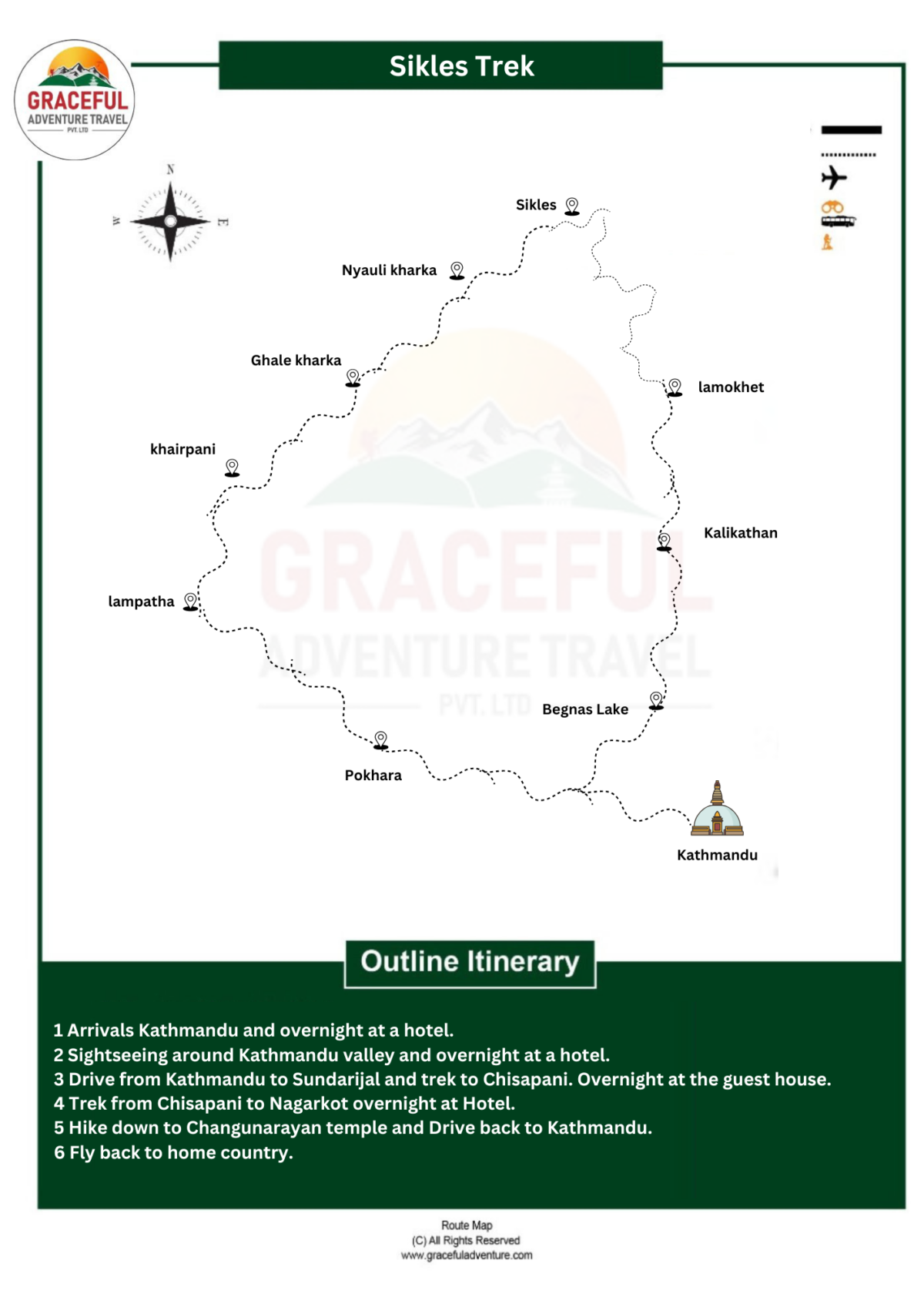
Sikles Trek is a comparatively lesser travelled trek, which gives you the authentic experience of trekking through unvisited villages and unperturbed natural landscape. The trail enables you to walk along peaceful ambience, isolated from the crowds of popular trek paths, and hence a perfect hideout for nature lovers and people who seek solace.
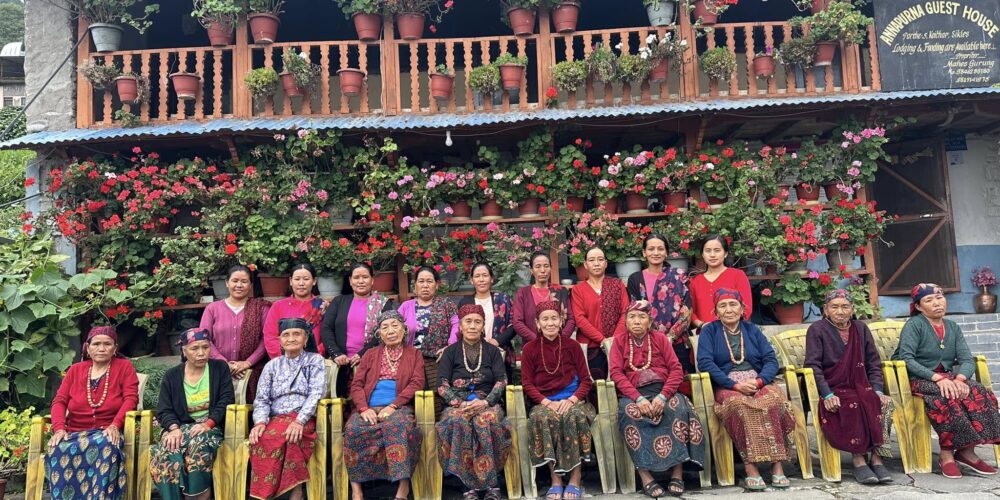
This is an opportunity to experience the rich culture of Gurungs and traditions. Sikles is among the biggest settlements of Gurung in Nepal, where tourists have an opportunity to taste warm hospitality, traditional way of life, and cultural performances, including folk songs and dance.
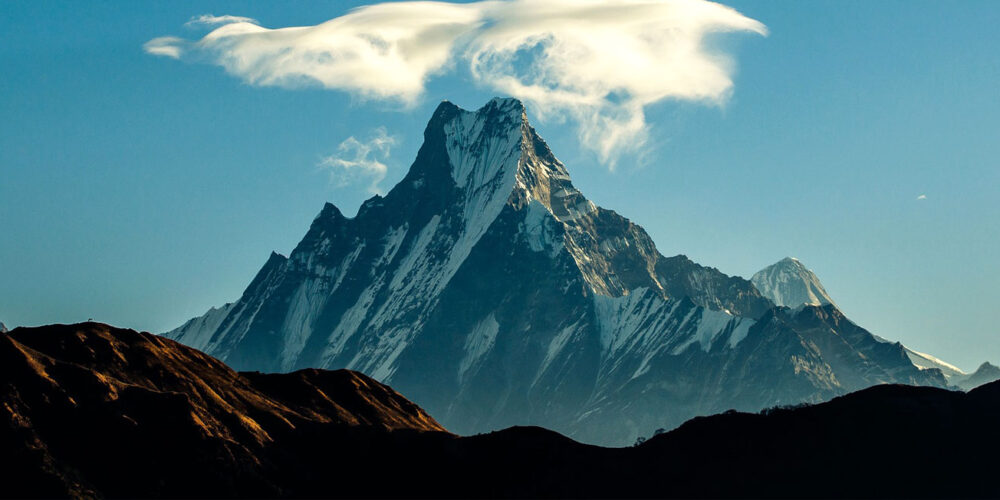
The trek provides trekkers with breathtaking views of Annapurna II, Lamjung Himal, and Machhapuchhre (Fishtail). The sun rise and sun set against the snow covered mountains is a breathtaking scene that completes the enchanting experience of the trip.
The route is varied ranging from dense forest, cascading waterfalls, and field terraces to alpine grasslands and rock. The trekkers move through forests of rhododendron trees, especially scenic in spring when the trees are in bloom.
Sikles and the surrounding area come under the Annapurna Conservation Area, and therefore it is home to diverse flora and fauna. The trekkers can spot Himalayan langurs, barking deer, and other birds, and also enjoy the peaceful and pristine environment.
The trek begins with a drive from Pokhara to Kharpani and then an ascend through terrace fields and forest to the scenic village of Sikles. From Sikles, following a tour, the trek ascends to Hugu Goth with good views of the mountains. The trek extends to Kapuche Glacier Lake, the lowest of the glacier lakes in Nepal, before returning back to Sikles. The last descend is to Tangting and a scenic drive back to Pokhara.
Sikles Trek is moderately challenging, and good physical fitness is anticipated. Trekkers must condition themselves to trek for 5-7 hours a day on steep and rocky trails. Basic cardio exercises like running and trekking can condition. Although the altitude is not great, gradual acclimatization is still necessary so that one feels comfortable in altitude terms.
Accommodation is mostly in teahouses and homestays, providing a warm and authentic village experience. The lodges have simple but cozy rooms with basic facilities. Food is traditional Nepali food such as dal bhat, roti, noodles, and local Gurung cuisine. As the trek goes to higher altitudes, food may be limited, so one should bring snacks and hydration materials.
Sikles Trek is the ideal combination of nature, culture, and adventure that offers a lifetime experience on one of Nepal’s most scenic and rural trekking trails.
There are many necessary equipment that trekkers have to carry during the treks. During the Sikles trek trekkers can stay at stars to local level hotels at Kathmandu and Pokhara. On the way they have to stay at local community house or tea house enjoying local cuisine but some places they have to stay on tent doing camping because at upper altitude we can’t find any permanent residence house so that trekkers have to carry necessary equipment and materials according to their stay .The necessary materials needed during the treks are as follows.

The best season for the Sikles Trek is during the spring (March to May) and autumn (September to November) months. During these times, the weather is generally clear, with mild temperatures and minimal rainfall, offering excellent visibility of the surrounding mountains. The spring season brings lush greenery, while autumn offers crisp air and clear skies. Both seasons provide ideal conditions for trekking, with comfortable temperatures and beautiful landscapes.
Spring Season
Spring season is one of the best seasons for the Sikles Trek. The temperature ranges from 10 to 20 degrees Celsius, which is perfect for trekking. Rhododendrons and other flowers are in bloom along the trekking trail, which offers wonderful scenery. The weather is clear most of the time, and the views of the surrounding mountains like Annapurna II, Lamjung Himal, and Machhapuchhre (Fishtail) are stunning.
Summer Season
Summer in Nepal coincides with the monsoon, and moderate showers are felt in the Sikles region. The trails become slippery, and trekking may not be easy with muddy paths. The temperature is 12 to 22 degrees Celsius in the lower regions. Though fewer tourists are encountered in the season, the lush scenery, foggy environment, and waterfalls contribute to a serene environment. Special care has to be taken due to the chances of landslides and unsettled weather patterns.
Autumn Season
Autumn also is the best time for the Sikles Trek, when the sky is clear and there are stunning views of the white snow-capped mountains. Monsoon dries up the trails, and the temperature ranges from 8 to 18 degrees Celsius, ideal for trekking. The season also coincides with the major Nepali festivals of Dashain and Tihar, and thus is a festive period for the villages. Despite the optimum weather, it can get somewhat crowded due to the favorable trekking weather.
Winter Season
Sikles winter trekking is more challenging due to snow and cold. The temperature drops up to 0 to -5 degrees Celsius, especially in the upper altitude, and hence trekking would be less comfortable. Trekkers can access lower regions of Sikles, but they have to carry adequate winter gear to protect themselves from the cold. Snow can hinder the upper trails and trekking will be less comfortable in this season.
The day begins early with day’s trek breakfast. Trekkers begin their trekking at about 7-8 am, trekking for 5-7 hours with regular breaks. Lunch is had at a viewing point or local tea house along the trekking trail. Trekkers continue their uphill and downhill trek in the afternoon and arrive at the night halt about 4-5 pm. Evenings are kept open to roam around villages or relax, and dinner can be had from 6-7 pm. Trekkers camp in teahouses or village homestays, where they socialize, read, or plan for the next day before retiring early at night.
Acclimatization is highly required during trekking the Sikles Trek, especially when the trekkers climb higher altitudes.Though the highest point of the trek is lower than other treks, altitude sickness can occur. Slow ascent, together with water intake, sufficient rest, and hot food, needs to be adhered to in order to avoid any chance of illness. Acclimatization rest days or acclimatization breaks are incorporated into the travel itinerary so that the trekkers adapt to the altitude transition. Achieving a daily altitude of no more than 300-500 meters is useful in reducing the risk of high-altitude sickness.
It is an easy trek but does have its set of challenges as well. The trek includes steep ascents, ridges that are small in width, and river crossings that demand high physical endurance. The terrain is usually rough, with part of it being trekkers walking on forest cover and alpine meadows. Weather can be uncertain with some rain and wet trails during monsoon, and the cold of winter can also add to the challenge. Less physically demanding compared to other treks but still requiring good planning and physical fitness to be in a position to do the trek safely.
It must be obtained by the trekkers in order to trek in Sikles. The Trekker’s Information Management System (TIMS) card is a compulsory document for every trekker, which must be obtained either in Kathmandu or Pokhara. The Annapurna Conservation Area Permit (ACAP) also has to be acquired as the trekking route is located within the Annapurna Conservation Area. The cost of the permit is approximately 3000 NRP per head. There are no restricted area permits to be obtained for this trek. The whole permits should be collected in advance prior to undertaking the trek to avoid delay during the trek.
There is electricity and mobile phone connectivity in the urban towns like Kathmandu and Pokhara, but no or very limited connectivity in the higher villages of the Sikles Trek. Power sources for devices are arranged at some secluded locations by trekkers, but at extra cost. Mobile connectivity is accessible in lower altitudes, but unreliable in higher altitudes. It is recommended to carry a power bank so that the devices stay charged. Satellite phones are accessible in case of need, but are generally available at higher camps or among guides.
ATMs and currency exchange centers are available in Kathmandu and Pokhara but not during the trek. The villages of Sikles Trek accept only Nepalese rupees, and thus trekkers should ensure that they exchange currency in Pokhara or Kathmandu before starting the trek. Adequate local money for food, water, and other essentials is required to avoid discomfort during the trek.
The spring (March to May) and autumn (September to November) seasons are ideal times to trek Sikles. The weather is beautiful, the sky is clear, and the scenery of the surrounding mountains, such as Annapurna II and Lamjung Himal, is spectacular. The weather is ideal for trekking with little chance of rain or snow.
Yes, the Sikles Trek is a moderate trek and can be accomplished by beginners with average physical fitness. While there are steep inclines, the trek is not as taxing as other high-altitude treks and is a great trek for beginners.
The Sikles Trek usually takes 5 to 7 days, depending on your pace, acclimatization needs, and itinerary. The trek is 60 to 70 kilometers long, and you will be trekking for approximately 5 to 7 hours per day.
Accommodation during the Sikles Trek is in homestays and local teahouses. These are simple in terms of facilities, offering sleeping accommodation, food, and, at times, charging facilities. Homestay in locals’ homes offers a chance to see Nepali culture and the hospitality of the people.
While you are free to trek on your own, it would be best for you to have a guide if you are new to trekking or do not know the trail. A guide not only ensures that you are secure but also shows you the way and shares information about the culture with you in the process. You can even hire porters to carry your bags if you wish.
The following permits will be needed to trek the Sikles Trek:
– TIMS (Trekker’s Information Management System) Card
– Annapurna Conservation Area Permit (ACAP)
Sikles Trek is of medium grade. There is little up and down walking, but the grade is not difficult for beginners with moderate body fitness. Altitude too is not great, and the highest altitude reached till date of trekking is about 2,100 meters, which lessens the chance of altitude sickness.
It is possible to trek Sikles in winter (December to February), though with some challenges in cold climatic conditions, especially at night. There will be snow in certain areas and the high passes will be snow-covered. You will require proper winter gear and preparation if you are going to trek in this period.
Weather in Sikles is lovely, between 10 to 20°C in the daytime. Nights are freezing, especially in winter. The best weather and cleanest sky is in spring and autumn and is good for trekking.
There is network in the lower villages but sketchy or nothing at higher elevations. Carry a power bank since it is always better to have your phone charged and charging facilities may be scarce or for cash in higher villages.
US$ 1080
Price starts
US$ 1080

