


Talk to Expert +9779856019412

Early bird offer for Everest base camp trek - 20% discount for 2026 & 2027.


US$ 750

Three Night Four Days Lhasa City tour is considered to be the heart and soul of Tibet. It is the largest city of Tibet and renowned as “City of Sunlight”. It is the most sought destination in Tibet where visitors and enjoy the spectacular and charismatic essence of the Tibetan nature, environment, and its wonders. Lhasa is an ancient city full of cultural wonders. This land of myths and mysteries is the holy abode of Dalai Lama. Lying at an elevation 0f 3660 m from sea level, this city gives a fantastic blend of culturally and historically rich sites and places worth paying a visit.
The major highlight of the Lhasa city tour visit includes the white fortress of Potala Palace, which is a UNESCO World Heritage Site. Similarly, you shall visit the attractions of Lhasa city tour Jhokong temple, Deprung Palace, Sera monastery, and Barkhor Street. This place is full of an overwhelming and intricate array of the monastery, temples, murals, exquisite art in the form of Tibetan Mandalas, eight tombs of the past Dalai lamas along with spectacular views of Tibetan highland plains. Similarly, you can see the local artifacts and handicraft goods in Barkhor street to estimate the richness of the culture and tradition of Tibetan People.
Lhasa city attracts thousands of visitors with its charming beauty and mysterious culture and tradition. This once so-called forbidden city for foreigners is now attracting visitors all around the globe. Lhasa is a beautiful shiny city that flourished with old and ancient monasteries, King Palaces, and a beautiful colored market to spend days sightseeing around.
Graceful adventure is a registered tour and travel company from Nepal who organizes various inbound and outbound travel packages from Nepal. Believing as the valued guest as a form of gods, we never leave any stone unturned until we help achieve the ultimate satisfaction of our valued guest. Our best deed and successful services for lhasa city tour to the customers have been promoting us to be in this athletic field from the running years. We will be delighted if we could arrange yours once in a lifetime experience.
| Season | Day Time Temperature | Night Time Temperature |
Spring (April-May) | 10°C to 18°C | -2°C to 5°C |
Summer (June-August) | 15°C to 22°C | 5°C to 10°C |
Autumn (September-November) | 10°C to 18°C | -2°C to 5°C |
Winter (December-February) | -5°C to 5°C | -10°C to -5°C |
Tour Name | Lhasa City Tour |
Maximum Elevation | 3,650 meters (Lhasa) |
Duration | 4 days (including sightseeing) |
Total Distance | Approx. 100-150 km (driving distance within Lhasa) |
Difficulty Level | Easy |
Best Time to Visit | April-May, September-November |
Accommodation | 3* Hotels (or similar) with breakfast (BB) |
Group Size | 1-12 people (ideal for guided group travel) |
| Day | Activity |
| 1 | Arrival in Lhasa. |
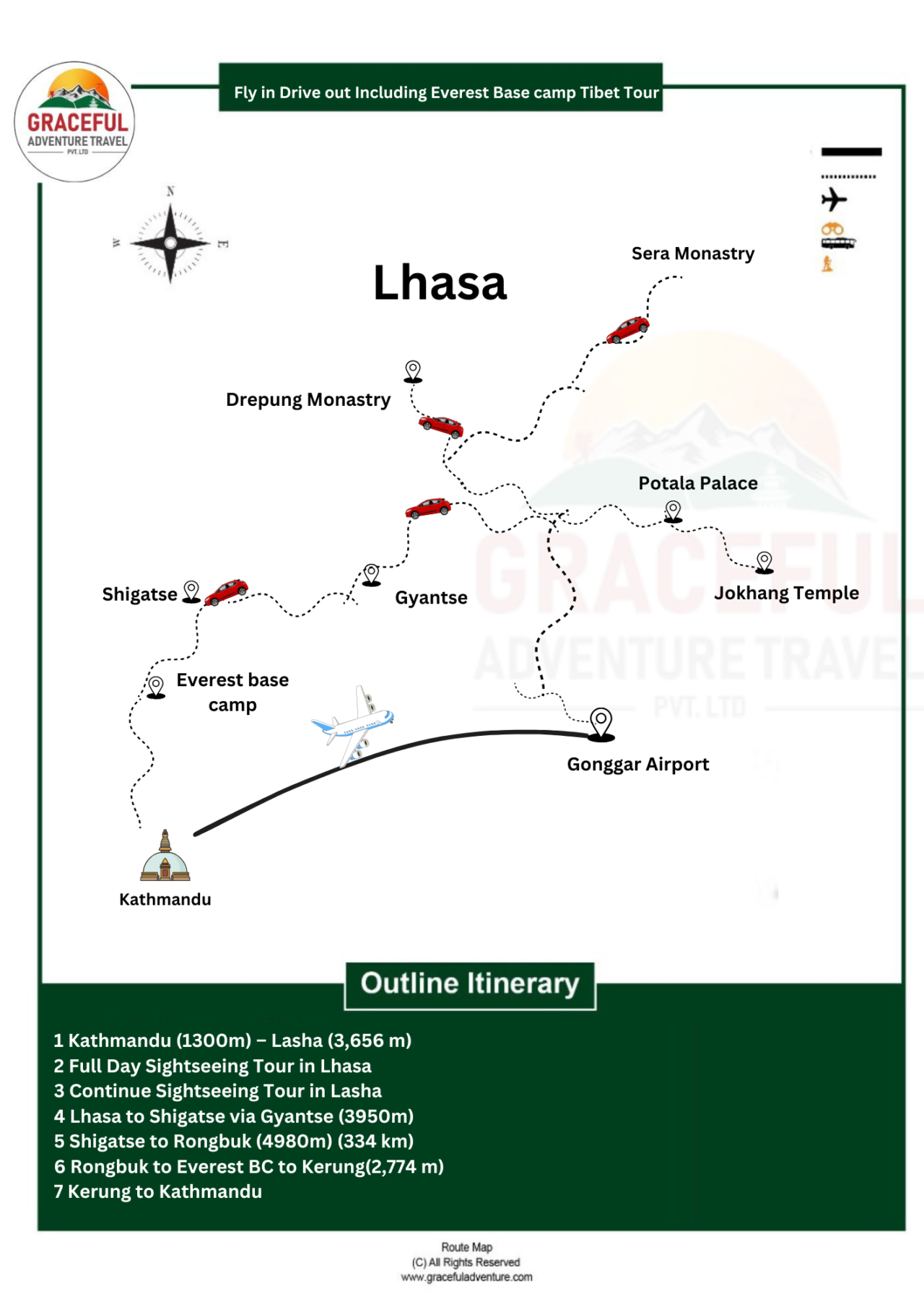
| 2 | Lhasa city sightseeing (POTALA PALACE, JOKHANG TEMPLE AND BARKHOR STREET) |
| 3 | Explore Deprung And Sera Monasteries |
| 4 | Return back to home |
Our representative will meet you at Gongnar Airport in Lhasa. You can fly in from Kathmandu or Chinese cities like Beijing, Chengdu, Shangai, Xian. Company person will escort you to the hotel in Lhasa. You will rest and enjoy the day at the hotel to adapt you to the higher altitude. We will manage you try local cuisines and culture in the evening.
Activity: Arrive Lhasa
Meal: BB
Accomodation: 3* hotel/similar
After your light breakfast in the morning, we will visit Potala Palace, the highest palace in the world, from where you will see the mesmerizing view of Lhasa city. This architectural wonder is full of gold aoring roof. From there, we move to the Jokhang temple, where you will learn the significant art culture of that place.
In the evening, we will visit you to Barkhor Street, where you will shop and see the local handicraft, souvenirs, and artifacts, which will definitely give the pleasure of “Real Lhasa.”
Activity: Sightseeing Lhasa City
Meal: BB
Accomodation: 3* hotel/similar
On this third day in Lhasa, we will take you to visit the most significant monasteries in Tibet-the Drepung and sera monastery. The deprung monastery was the one-time world’s largest monastery with 10000 monks residing in it. Here, you will find the solemn peace of yourself and learn the essence of the religion.
After that, you will visit the sera monastery where you will see the red-robed monks chanting and debating a lot. It’s quite a place in the suburb to see the very debate of the monk and, most importantly, learn and understand Buddhist art culture and scriptures. Sera monastery is the repository location to observe ancient Tibetan art, culture, scripture, and history.
Activity: Explore Monasteries
Meal: BB
Accomodation: 3* hotel/similar
On this final day at Lhasa, our representative will escort you to Gongnar airport from where you will take a fly out to your home country. If you take a flight from Nepal, you can once again enjoy the spectacular views of Himalayan ranges and peaks of the world-famous mountains.
Activity: back to kathmandu/home
If our standard itinerary doesn't fully meet your needs, we are happy to tailor it to your specific preferences and requirements.
It is the tour of the very iconic Potala Palace, a UNESCO World Heritage Site and the former winter residence of the Dalai Lama. Standing regally on Red Hill, this grand structure provides sweeping views of Lhasa and boasts Tibetan history, culture, and intricate Buddhist art. The palace has stunning gilded roofs, sacred chapels, and old murals that recount Buddhist legends, quite an experience for the visitors.
Jokhang Temple
It is yet another major sightseeing attraction that is considered the spiritual heart of Tibet. It holds sacred the statue of Jowo Shakyamuni, which is regarded as one of the holiest relics in Tibetan Buddhism. And while circumambulating the temple in a clockwise direction, pilgrims from various parts of Tibet spin prayer wheels and chant mantras, thus holding a deep spiritual ambiance. It is certainly an artistic marvel, combining architectural styles from Nepal, India, and Tibet.
Barkhor Street
The encircling Jokhang Temple is a colourful market and the path of pilgrimage for visitors to experience Tibetan ways. Lined with shops selling prayer flags, handmade jewelry, traditional costumes, and souvenirs, Barkhor is a crowded street. Walking around Barkhor gives tourists the chance to see Tibetan people going about their daily lives, with monks and locals joining pilgrims doing kora, ritual circumambulation of the temple.
Drepung Monastery
It is the formerly the largest monastery of Tibet, is yet another worthy site to visit. It is said to lie below Mount Gambo Utse and has been a very important centre for Tibetan Buddhism, housing thousands of monks. The visitors can walk in its vast assembly halls, through ancient scriptures and the quiet serene of the monastery courtyards, with gorgeous views of the surrounding mountain scenery. The monastery shows great merit regarding knowledge about monastic life and Buddhist teachings in Tibet.
Sera Monastery
It is famous for debates unique to monks held on the courtyard grounds of the monastery. This particular debate is essential to learn Buddhist philosophy and learning, complemented further by gesturing and clapping. It features stunning murals, sacred statues, and scriptures in immaculate condition. Witnessing and being a part of these debates will provide a rare and exciting insight into the scholarly traditions of Tibetan Buddhism.
Lasting for three nights and four days, Lhasa City visit tour package begins with a delightful flight from Kathmandu to Lhasa over the majestic Himalayas. Upon arrival in Lhasa, the travelers would be brought to a variety of Tibetan spiritual centers, such as Potala Palace, Jokhang Temple, and Barkhor Street. Acclimatization and enjoying the rich culture of Lhasa will be assigned to Day 1. Second-day activities will cover a visit to Drepung and Sera Monasteries, where guests will have the opportunity to observe Tibetan monastic life and tranquility. The third day continues with a visit to Norbulingka, the summer palace of the Dalai Lama, and Tibetan Museum to learn more about the history and culture of the region. The last day gives chances for final glimpses of Lhasa before departure back to Kathmandu. The itinerary leads into a leisurely-paced experience, expertly mixing cultural activities and sightseeing; accordingly, it serves the interests of visitors looking to snatch the essence of Lhasa in a short time frame.
The spring season (April to June) and autumn season (September to November) provide the best opportunity for experiencing Lhasa for three nights and four days. The weather during these two seasons is convenient for sightseeing, with clear skies and mild temperatures favorable for wandering and discovering the sacred spots in Lhasa.
Spring Season:
The spring season between April and June is regarded as one of the best times to visit Lhasa due to pleasant temperatures and fairly pleasant weather on the Tibetan plateau, where flowers start to bloom. As a result, pleasant weather with clear skies and rejuvenating air during springtime is best suited for the exploration of Lhasa’s spiritual as well as cultural sites since winter can be harshly cold.
Autumn Season:
Autumn, from September to November, is another excellent time to visit. Another favorable time frame for venturing to Lhasa is autumn, stretching from September to November, with clear skies and cool temperatures, thus providing the ideal opportunity to travel. The golden colors of the Tibetan grasslands and serenity of sacred lakes induce a quiet and calming environment for the travelers to completely soak in the beauty and tranquility of the land.
Lhasa and its surrounding areas provide typical Tibetan, Chinese and Nepalese cuisines in the midst of good food. You can enjoy many traditional Tibetan foods such as tsampa (roasted barley flour), thukpa (noodle soup), and momos (dumplings). Butter tea is a common staple of Tibetan culture. The food in Lhasa is also diverse, from different restaurants serving local and international dishes. Mostly, meals take the simple form of rice, vegetables, and soup when at places such as the outskirts of Lhasa. Snacks are the best to carry for the journey, especially if traveling into higher altitudes and food stops become even less frequent.
The accommodation offered on this Three Night Four Days Tour to Lhasa City depends on where you are located. Moderate hotels with the luxury of hot showers, Wi-Fi, and comfortable beds are some of the best standards in Lhasa. While further up near Everest Base Camp or Lake Mansarovar, it becomes even more basic. Guesthouses in these areas typically have dormitory-style rooms with basic bedding and shared bathrooms. The heating or the electricity might not be found in some places; hence, warm clothing is required for staying comfortable during your stay in these more rustic locations.
Using a combination of air and road transport, the tour of Three Night Four Days Lhasa City will kick off the journey with a scenic flight from Kathmandu to Lhasa. Here, travelers can enjoy a majestic sight of the Himalayas. Private vehicles are then thereafter used for intra-city travel and to do the main landmarks of Lhasa. Most roads in and around Lhasa are paved and well-maintained; however, some high-altitude roads may present bumpy terrain. Comfortable tourist vehicles such as 4WDs or minibuses would be provided depending on the size of the group. Such fantastic drivers have years of experience in the region, making their journeys an outstanding piece of work with a few breaks for acclimatization and scenery sweeping views of Tibet’s topography.
Quite unlike travel to Lhasa, the spiritual and cultural capital of Tibet, with difficulties imposed by high altitude and remote locations, is represented within the confines of travel insurance which serves to ease one or rather allow for a smooth holiday. Risks of altitude sickness and unforeseen medical emergencies enhance the desirability of coverage for emergency medical treatment, evacuation, and hospitalization including altitude sickness. Peace of mind is afforded when traveling to Lhasa city tour with ample travel insurance since protection from unexpected circumstances is assured.
1. Emergency Medical Treatment
With high altitude travel areas such as Lhasa, a myriad of altitude sicknesses, injuries, or dehydration could pose threats to life. Coverage in good travel insurance policies for emergency medical treatment should ensure that any health problem coming up is treated. Such an insurance policy ensures that when health concerns come up, prompt medical attention should be accessed, whether altitude sickness or an injury – yet another crucial aspect in such inhospitable places.
2. Emergency Evacuation
Should your medical emergency turn serious and you urgently need evacuation, emergency evacuation coverage is a matter of importance. If at Lhasa’s high-altitude sites or somewhere on the fringes of civilization, being assured of an evacuation via helicopter or surface means to the medical facility nearest to you could mean life or death. The coverage here guarantees you will never be left stranded when you require medical assistance.
3. Altitude Sickness Treatment
Trekking at high altitudes in Lhasa is a guarantee for altitude sickness (AMS, HAPE, HACE), so altitude sickness treatment should be included in your travel insurance coverage. This should cover the costs of oxygen therapy, medical consultations, and, if need be, your evacuation to a lower altitude for recuperation. Such a benefit guarantees that you receive the care associated with altitude sickness.
4. Hospitalization Coverage
In the unfortunate event that you fall seriously ill or are injured, hospitalization may nonetheless be deemed compulsory. Your insurance policy must give full hospitalization expenses, including room rent, surgery, and any other medical treatment that may be necessitated. This puts you free of hospital obligations and enables your treatment in Tibet or at the nearest medical facility with absolutely no concern about the finances.
5. Outpatient Treatment
In the case of minor illnesses or injuries such as headaches, sprained ankles, or fever, outpatient treatment should be available under your travel insurance. This includes consultations with doctors and the cost of medications for whatever treatment you need. Hence, should you happen not to require admission, your travel insurance for each day in Lhasa will still be accessed for medical care.
Graceful Adventure Travel is a reliable, well-established tour operator offering tourists on a Three Night Four Days Lhasa City Tour a secure and enriching experience. This company provides comprehensive support, handling travel permits, accommodation, and responsible transportation. Their guides are experienced in managing the high-altitude trekking challenges and are committed to ensuring that all logistics are i place throughout the journey. Service with Graceful Adventure Travel is all about safety and customer satisfaction. This tour company provides a smooth, well-managed tour experience from cultural highlights of Lhasa to the stunning landscapes of Tibet.
The best time to visit Lhasa is during the spring (April to June) and autumn (September to October). These seasons offer mild weather, clear skies, and the best conditions for sightseeing.
Yes, you will need a China visa for the Tibet tour. The Tibet Travel Permit, which is necessary for traveling in Tibet, will be arranged by the tour operator. You must apply for a China visa separately before the tour.
You will take a flight from Kathmandu to Lhasa, and this journey will give you beautiful views of the Himalayas.
Lodging will be in comfortable hotels or guesthouses during the entire tour. This may include places where very basic accommodation is available and at high levels where the areas become really thin.
Breakfast will be included on all days of the tours; lunch and dinner are generally excluded except where mentioned in an itinerary. You’ll also have a chance to try some local Tibetan food while on the tour.
Yes, it is a problem because Lhasa is very high above sea level. The tour would provide oxygen in case of emergencies and breaks during the trip, making it healthier for acclimatization. So, just take it easy and keep hydrated.
You need to carry your personal belongings such as trekking gear, warm clothes, and anything else- national parks won’t include personal gear in a trip, but there may be rental options down the line in Tibet.
Travel insurance should cover medical emergencies, altitude sickness treatments, emergency evacuation, and any unforeseen events such as delays or cancellations. Therefore, it is very highly recommended to get complete travel insurance to have peace of mind during the trip.
Pick-up vehicles will include privately licensed camping vehicles such as a 4WD or minibus, depending on the number of people traveling and the kind of roads they’ll hope to take. To add on that, these vehicles will also be some of the comfiest imaginable since they’re also meant for rugged Tibetan roads.How long does it take from Kathmandu to Lhasa?
The length of the flight from Kathmandu to Lhasa is approximately between 1.5 -2 hours.
US$ 750
Price starts
US$ 750

